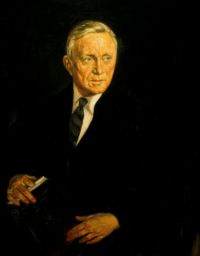
William O. Douglas

William O. Douglas

Summary

Portrait of William O. Douglas William O. Douglas Edelman v. Jordan — Dissent Douglas (1974)

Where a State has consented to join a federal-state cooperative project, it is realistic to conclude that the State has agreed to assume its obligations under that legislation. There is nothing in the Eleventh Amendment to suggest a difference between suits at law and suits in equity, for it treats the two without distinction. If common sense has any role to play in constitutional adjudication, once there is a waiver of immunity it must be true that it is complete so far as effective operation of the state-federal joint welfare program is concerned.
Source: Wikisource

Portrait of William O. Douglas William O. Douglas Edelman v. Jordan — Dissent Douglas (1974)

Every person who, under color of any statute, ordinance, regulation, custom, or usage, of any State or Territory, subjects, or causes to be subjected, any citizen of the United States or other person within the jurisdiction thereof to the deprivation of any rights, privileges, or immunities secured by the Constitution and laws, shall be liable to the party injured in an action at law, suit in equity, or other proper proceeding for redress.
Source: Wikisource

Portrait of William O. Douglas William O. Douglas Edelman v. Jordan — Dissent Douglas (1974)

A State's immunity from suit by an individual without its consent has been fully recognized by the Eleventh Amendment and by subsequent decisions of this Court. But when a State leaves the sphere that is exclusively its own and enters into activities subject to congressional regulation, it subjects itself to that regulation as fully as if it were a private person or corporation." Id., at 196.
As the Court of Appeals in the instant case concluded, Illinois by entering into the joint federal-state welfare plan just as surely " [left] the sphere that is exclusively its own."
Source: Wikisource

Get perspective with Kwize: daily news enlightened by great literature