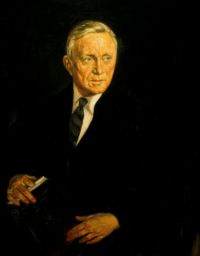
William O. Douglas

William O. Douglas

Summary

Portrait of William O. Douglas William O. Douglas Ungar v. Sarafite — Dissent

Thus, long before the contempt trial-long before the contempt charge had been filed-the judge, who later sentenced the witness for contempt, had concluded and stated in so many words-that the witness was 'contemptuous.' It is a travesty on American justice to allow a judge who has announced his decision on the issue of guilt prior to the trial to sit in judgment at the trial.
Judges are human; and judges caught up in an altercation with a witness do not have the objectivity to give that person a fair trial.
Source: Wikisource

Portrait of William O. Douglas William O. Douglas Ungar v. Sarafite — Dissent

He charged him with contempt for refusing to answer. We reversed the conviction, saying,
'It would be very strange if our system of law permitted a judge to act as a grand jury and then try the very persons accused as a result of his investigations. Perhaps no State has ever forced a defendant to accept grand jurors as proper trial jurors to pass on charges growing out of their hearings. A single 'judge-grand jury' is even more a part of the accusatory process than an ordinary lay grand juror.
Source: Wikisource

Portrait of William O. Douglas William O. Douglas Ungar v. Sarafite — Dissent

The right of a defendant to examine and cross-examine witnesses is too essential to a fair trial to have that right jeopardized in such way.' 349 U.S., at 139, 75 S.Ct., at 626, 99 L.Ed. 942.
An impartial judge, not caught up in the cross-currents of emotions enveloping the contempt charge, is the only one who can protect all rights and determine whether a contempt was committed or whether the case is either one of judicial nerves on edge or of judicial tyranny.
Source: Wikisource

Get perspective with Kwize: daily news enlightened by great literature