Summary

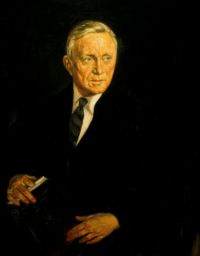
Portrait of William O. Douglas William O. Douglas United States v. Shirey — Concurrence

The Government has strongly urged, in an effort to avoid the District Court's holding that the specific mention of 'political contribution' in § 215 implied its exclusion from the term 'thing of value' in § 214, that the two sections are plainly reciprocal and must be construed in pari materia. I agree. There is not the slightest indication in the sparse legislative history that Congress intended that the 'purchase' and 'sale' provisions of the statute should have different scope, nor has any reason which would reasonably support a difference in scope been suggested to us.
Source: Wikisource

Portrait of William O. Douglas William O. Douglas United States v. Shirey — Concurrence

Entirely apart from the statutory history, however, I think it a remarkable construction of the language of § 214 to find that an offer to X to pay money to Y, with whom X is not claimed to have any financial relationship, is an offer of money to X. Under these circumstances there is an offer to X, but it is plainly an offer to perform an act (pay money to Y) rather than an offer of money to X. The statute does not say that any offer to a person involving money is rendered criminal if the other statutory criteria are met, but only that an offer of money to a person may be.
Source: Wikisource

Portrait of William O. Douglas William O. Douglas United States v. Shirey — Concurrence

I think it plain that this language would not have reached one who solicited, in consideration of the promise of his influence, a general political contribution of money to be paid directly to his party. Under such circumstances the political party would be the 'payee' of the money, but it would be the influence of the solicitor, as opposed to that of the party, which was promised.
Source: Wikisource

Get perspective with Kwize: daily news enlightened by great literature