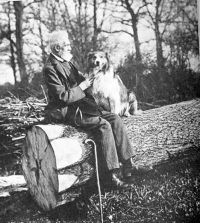
Worthington George Smith

Worthington George Smith

Summary

Portrait of Worthington George Smith Worthington George Smith Our Cover — Midland Naturalist…

Many readers of the "Midland Naturalist" will probably be self-taught men, who busily follow industrial occupations every week-day. It may therefore interest such readers to know that the writer of these lines never had any teacher, either artistic or scientific, other than he always found supplied to him by close observation, careful reading, experience, and constant perseverance.
Source: Wikisource

Portrait of Worthington George Smith Worthington George Smith Our Cover — Midland Naturalist…

The Actinopharis, (Actinopharis Elhornii,) on the right points to the Rhizopods, and the Ferns and Fungi beneath are representatives of Cryptogamic Botany. The Apteryx, (Apteryx Australis,) and Octopus, (Octopus vulgaris,) represent rare and curious animals, and at the same time point to Ornithology and the Mollusca. The Ichthyosaurus at the base is a representative of animals long extinct, and now found in a fossil condition only.
Source: Wikisource

Portrait of Worthington George Smith Worthington George Smith Our Cover — Midland Naturalist…

The study of animals recently extinct is indicated by the sketch of the Mammoth, (Elephas primigenius,) in the ice, and of living animals by the drawing of the Red Deer, (Cerrus Elephus.) The philosophical instruments at the top. Spectroscope, microscopes, and telescopes, need no word of explanation. The Cromlech, flint arrow-head, and stone hammier point to pre-historic Archæology; the Cromlech represents the magnificent monument still standing near the village of Clynnog, in Carnarvonshire. The cup stone of this Cromlech is profusely dotted over with the enigmatic "cup-markings;"
Source: Wikisource

Get perspective with Kwize: daily news enlightened by great literature