Summary

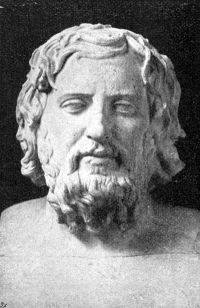
Portrait of Xenophon Xenophon Hellenica (Xenophon) — Book 6, Chapter 5 (1890s)

I daresay, men of Athens, there is a double answer to the question, Who began the wrongdoing? But take the case of ourselves. Since peace began, no one can accuse us either of wantonly attacking any city, or of seizing the wealth of any, or of ravaging a foreign territory. In spite of which the Thebans have come into our country and cut down our fruit-treees, burnt to the ground our houses, filched and torn to pieces our cattle and our goods.
Source: Wikisource

Portrait of Xenophon Xenophon Hellenica (Xenophon) — Book 6, Chapter 5 (1890s)

What would happen, men of Athens, if the Lacedaemonians were well out of the way? The answer to that question is obvious. You would be the first object of Theban invasion. Clearly; for they must feel that you and you alone stand in the path between them and empire over Hellas. 39If this be so, I do not consider that you are more supporting Lacedaemon by a campaign in her behalf than you are helping yourselves. For imagine the Thebans, your own sworn foes and next-door neighbours, masters of Hellas! You will find it a painful and onerous exchange indeed for the distant antagonism of Sparta.
Source: Wikisource

Portrait of Xenophon Xenophon Hellenica (Xenophon) — Book 6, Chapter 5 (1890s)

The Lacedaemonian ambassadors were Aracus, Ocyllus, Pharax, Etymocles, and Olontheus, and from the nature of the case they all used, roughly speaking, similar arguments. They reminded the Athenians how they had often in old days stood happily together, shoulder to shoulder, in more than one great crisis. They (the Lacedaemonians) , on their side, had helped to expel the tyrant from Athens, and the Athenians, when Lacedaemon was besieged by the Messenians, had heartly leant her a helping hand.
Source: Wikisource

Get perspective with Kwize: daily news enlightened by great literature