“ The story of the Battle of Colenso is mainly the narrative of the action of two important components of the Army of Natal. Each of these was led by a dangerously {73} brave man, whose impetuosity crippled the tactical scheme and whose method of working his command was, at least, unusual. If in Hart and Long, who commanded the Artillery, the quality of personal courage had been less prominent it is probable that Colenso would not have filled up the cup of Stormberg and Magersfontein in that dark midsummer December week. ”
Battle of Colenso
Definition and stakes
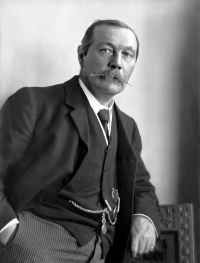
The Battle of Colenso, fought on 15 December 1899 during the Second Boer War, marked a crucial British setback against Boer forces in Natal, South Africa. Weak command, insufficient scouting, and difficult terrain resulted in significant British losses. Writers such as Arthur Conan Doyle criticized the strategic missteps, while Marie Corelli reflected the public's distress in England.
A. G. Hales focused on the harsh environment, and Boer narratives, including Ben J. Viljoen’s, pointed out the chaos caused by contradictory orders. These differing viewpoints highlight how Colenso symbolized the British challenge in countering Boer guerrilla warfare, influencing the war's initial course.
Quotes about “Battle of Colenso”
Marie Corelli,
Boy: A Sketch
(1900)
“ At home in England the news of the battle of Colenso and the capture of the British guns was received by a whole world with incredulity and dismay. Throngs of people crowded the War Office, clamouring for news—pouring out inquiries and lamentations,—reading the terrible list of casualties, and while reading scarcely believing what their own eyes beheld. ”
Ben J. Viljoen, My Reminiscences of the Anglo-Boer War
“ At last came the welcome order summoning us to action; and we were bidden to march on Colenso Heights with 200 men to fill up the ranks, as a fight was imminent. (p. 079) We left under General Cronje and arrived the next morning at daybreak, and a few hours after began the battle now known to the world as the Battle of Colenso (15th December, 1899) .I afterwards heard that the commandos under General Cronje were to cross the river and attack the enemy's left flank. This did not happen, as the greatest confusion prevailed owing to the various contradictory orders given by the generals. ”
Arthur Conan Doyle,
The Great Boer War — Chapter 11 Battle of Colenso
(1900)
“ Nor is there any evidence that the loss of these guns did seriously affect the fate of the action, for at those other parts of the field where the infantry had the full and unceasing support of the artillery the result was not more favourable than at the centre.So much for Colenso. A more unsatisfactory and in some ways inexplicable action is not to be found in the range of British military history. And the fuller the light which has been poured upon it, the more extraordinary does the battle appear. ”
Spenser Wilkinson,
Lessons of the War: Being Comments from Week to Week to the Relief of Ladysmith
“ There has been no substantial, visible change in the military situation since the battle of Colenso on December 15th. The actions of General French at Colesberg and of Colonel Pilcher at Sunnyside are valuable mainly as evidence that with sound tactics the Boers are by no means invincible, and that British troops only require intelligent leading to be as capable of the best work as any troops in the world. ”
A. G. Hales, Campaign Pictures of the War in South Africa…
“ The worst fighting ground that I saw in all the Free State was but a mockery of war compared to the ground around Colenso, and I have seen some terrible places in the Free State. But a man has to see the ground Buller fought in to realise the magnitude of the task the Empire set him at the beginning of the war. Great as Lord Roberts is, I doubt if he would have done more than Buller did under the same circumstances.That battle of Colenso made young Louis Botha famous, and from that hour the eyes of the burghers were turned towards him as the one man fit to lead them. ”
Ten Months in the Field with the Boers
“ I have protested, but I must obey or give up my sword.... The men of the Modder River army will probably never follow Lord Methuen in another engagement.'Finally, on December 15, the Battle of Colenso was fought. I borrow an account of it from Sir Redvers Buller's telegram despatched from Chieveley Camp in the evening:'I regret to report serious reverse. I moved in full strength from camp near Chieveley this morning at 4 a.m. There are two fordable places in the Tugela, and it was my intention to force a passage through at one of them. ”
Louis Creswicke, South Africa and the Transvaal War…
“ THE BATTLE OF COLENSO—THE LAST DESPERATE ATTEMPT TO SAVE THE GUNS OF THE 14th and 66th BATTERIES.Drawing by Sidney Paget.Sad to state, our ambulances were designedly fired upon. Five shells fell in the neighbourhood of a waggon packed with wounded, and one party of ambulance men was forced twice to abandon their work of succour. The tents of the field-hospitals were no sooner erected than shells fell all round them, and the men were forced to desist from their labours. The heroic conduct of the civilian stretcher-bearers was generally the subject of remark. ”
Lady Beatrix Wickens Davey Gatacre, General Gatacre
“ The anxiety felt by the commanders of the three detached forces in South Africa was shared by the nation at home. The telegrams sent to England by Sir Redvers Buller showed that the state of affairs in Natal after the battle of Colenso was very critical, and that only prompt and ample reinforcements would be of any avail. Troops of all arms were despatched to Capetown as fast as ships could be got ready to carry them, and Field-Marshal Lord Roberts was appointed Commander-in-Chief, with Lord Kitchener as his chief staff officer. ”
Arthur Conan Doyle,
The Great Boer War — Chapter 11 Battle of Colenso
(1900)
“ Other methods of attack must be found or attacks must be abandoned, for smokeless powder, quick-firing guns, and modern rifles make it all odds on the defence!The gallant Irishmen pushed on, flushed with battle and careless for their losses, the four regiments clubbed into one, with all military organisation rapidly disappearing, and nothing left but their gallant spirit and their furious desire to come to hand-grips with the enemy. Rolling on in a broad wave of shouting angry men, they never winced from the fire until they had swept up to the bank of the river. ”
Arthur Edward Mainwaring, The Second Battalion Royal Dublin Fusiliers in the South African War
“ General Sir Redvers Buller had early recognised the difficulties of the 5th Brigade, and sent orders for it to retire. But it is easier to send a force into a battle than to draw it back. The great difficulty at Colenso was to communicate with the company officers, who had to be left entirely to their own 'initiative.' Finally an officer of the Connaught Rangers volunteered to take to the firing line General Hart's written order to retire. ”
Arthur Conan Doyle,
The Great Boer War — Chapter 11 Battle of Colenso
(1900)
“ But making every allowance for the pressure of many duties and for the confusion and turmoil of a great action, it does seem one of the most inexplicable incidents in British military history that the guns should ever have been permitted to fall into the hands of the enemy. It is evident that if our gunners could not live under the fire of the enemy it would be equally impossible for the enemy to remove the guns under a fire from a couple of battalions of our infantry. There were many regiments which had hardly been engaged, and which could have been advanced for such a purpose. ”
Arthur Conan Doyle,
The Great Boer War — Chapter 11 Battle of Colenso
(1900)
“ Meanwhile on the extreme right the mounted troops under Dundonald were to cover the flank and to attack Hlangwane Hill, a formidable position held strongly by the enemy upon the south bank of the Tugela. The remaining Fusilier brigade of infantry was to support this movement on the right. The guns were to cover the various attacks, and if possible gain a position from which the trenches might be enfiladed. This, simply stated, was the work which lay before the British army. In the bright clear morning sunshine, under a cloudless blue sky, they advanced with high hopes to the assault. ”
Arthur Conan Doyle,
The Great Boer War — Chapter 11 Battle of Colenso
(1900)
“ The whole operation, with its advance over the open against a concealed enemy with a river in his front, was so absolutely desperate that Long may have seen that only desperate measures could save the situation. To bring guns into action in front of the infantry without having clearly defined the position of the opposing infantry must always remain one of the most hazardous ventures of war. ”
“ The capture of Botha's Pass was an affair which did credit to Buller. It showed that since Colenso he had learnt how to use artillery, and his disposition of his guns was admirable. They rendered the enemy's position untenable and left little but hard climbing to the infantry. It can hardly be termed a battle, it was rather an autumn manoeuvre engagement, conducted on Lord Roberts' principles. A very important position was won and the enemy driven back with scarcely the shedding of a drop of blood on either side. Hildyard was in executive charge of the operations. ”
Arthur Conan Doyle,
The Great Boer War — Chapter 11 Battle of Colenso
(1900)
“ Dundonald's force was entirely too weak for such an operation as the capture of the formidable entrenched hill, and it is probable that the movement was meant rather as a reconnaissance than as an assault. He had not more than a thousand men in all, mostly irregulars, and the position which faced him was precipitous and entrenched, with barbed-wire entanglements and automatic guns. But the gallant colonials were out on their first action, and their fiery courage pushed the attack home. ”
Arthur Conan Doyle,
The Great Boer War — Chapter 11 Battle of Colenso
(1900)
“ It may be, though it seems incredible, that the river had been partly dammed to deepen the Drift, or, as is more probable, that in the rapid advance and attack the position of the Drift was lost. However this may be, the troops could find no ford, and they lay down, as had been done in so many previous actions, unwilling to retreat and unable to advance, with the same merciless pelting from front and flank. In every fold and behind every anthill the Irishmen lay thick and waited for better times. ”
Arthur Conan Doyle,
The Great Boer War — Chapter 11 Battle of Colenso
(1900)
“ Our own close formations, our adherence to volley firing, and in this instance the use of our artillery all seem to be legacies of our savage wars. Be the cause what it may, at an early stage of the action Long's guns whirled forwards, outstripped the infantry brigades upon their flanks, left the slow-moving naval guns with their ox-teams behind them, and unlimbered within a thousand yards of the enemy's trenches. ”
Arthur Conan Doyle,
The Great Boer War — Chapter 11 Battle of Colenso
(1900)
“ With the help of the naval guns it did what it could to extricate and cover the retreat of the Irishmen, but it could play no very important part in the action, and its losses were insignificant. On its right in turn Hildyard's English Brigade had developed its attack upon Colenso and the bridge. The regiments under Hildyard's lead were the 2nd West Surrey, the 2nd Devons (whose first battalion was doing so well with the Ladysmith force) , the East Surreys, and the West Yorkshires. ”
Arthur Conan Doyle,
The Great Boer War — Chapter 11 Battle of Colenso
(1900)
“ On the other hand, if, as the orders of the day seem to show, a serious engagement was always intended, it is strange that two brigades out of four should have played so insignificant a part. To Barton's Brigade was given the responsibility of seeing that no right flank attack was carried out by the Boers, and this held it back until it was clear that no such attack was contemplated. After that one would have thought that, had the situation been appreciated, at least two battalions might have been spared to cover the abandoned guns with their rifle fire. ”
Arthur Conan Doyle,
The Great Boer War — Chapter 11 Battle of Colenso
(1900)
“ It was one of many occasions in this war in which one wondered why, if a bullet-proof shield capable of sheltering a lying man could be constructed, a trial should not be given to it. Alternate rushes of companies with a safe rest after each rush would save the troops from the continued tension of that deadly never ending fire. ”
Arthur Conan Doyle,
The Great Boer War — Chapter 11 Battle of Colenso
(1900)
“ Our wounded fortunately bore a high proportion to our killed, as they always will do when it is rifle fire rather than shell fire which is effective. Roughly we had 150 killed and about 720 wounded. A more humiliating item is the 250 or so who were missing. These men were the gunners, the Devons, and the Scots Fusiliers, who were taken in the donga together with small bodies from the Connaughts, the Dublins, and other regiments who, having found some shelter, were unable to leave it, and clung on until the retirement of their regiments left them in a hopeless position. ”
Arthur Conan Doyle,
The Great Boer War — Chapter 11 Battle of Colenso
(1900)
“ Officers and men were falling fast. The guns could not be worked, and yet they could not be removed, for every effort to bring up teams from the shelter where the limbers lay ended in the death of the horses. The survivors took refuge from the murderous fire in that small hollow to which Long had been carried, a hundred yards or so from the line of bullet-splashed cannon. ”
Erskine Childers,
In the Ranks of the C.I.V
“ The I.L.H. man is very interesting. Like most of his corps, which was recruited from the Rand, he has a position on a mine there, and must be well over forty. He had been through the Zulu war too. His squadron was with Buller all through the terrible struggle from Colenso to Ladysmith, which they were the first to enter. They were shipped off to the Cape and sent up to relieve Mafeking with Mahon. He has been in scores of fights without a scratch, but now has veldt sores. He says Colenso was by far the worst battle, and the last fortnight before the relief of Ladysmith was a terrible strain. ”
Arthur Conan Doyle,
The Great Boer War — Chapter 11 Battle of Colenso
(1900)
“ We had not even the satisfaction of knowing that we had inflicted as well as endured punishment, for the enemy remained throughout the day so cleverly concealed that it is doubtful whether more than a hundred casualties occurred in their ranks. Once more it was shown how weak an arm is artillery against an enemy who lies in shelter. ”
Arthur Conan Doyle,
The Great Boer War — Chapter 11 Battle of Colenso
(1900)
“ Leaving their horses, they advanced a mile and a half on foot before they came within easy range of the hidden riflemen, and learned the lesson which had been taught to their comrades all along the line, that given approximately equal numbers the attack in the open has no possible chance against the concealed defence, and that the more bravely it is pushed the more heavy is the repulse. ”
Great Britain. War Office, History of the War in South Africa 1899-1902 v…
“ Colenso is a fortress, which I think, if not taken on a rush, could only be taken by a siege. There is no water within eight miles of the point of attack, and in this weather that exhausts infantry. The place is fully entrenched. I do not think either a Boer or a gun was seen by us all day, yet the fire brought to bear was very heavy. Our infantry were quite willing to fight, but were absolutely exhausted by the intense heat. My view is that I ought to let Ladysmith go, and occupy good positions for the defence of South Natal, and let time help us. ”
“ The enemy conducted the war upon principles which were strange to the British Army, and to which it had to adapt itself painfully; and the men seem to have recognized sooner than the professors the difficulties of the situation, and to have been less intolerant of ill-success.Few general officers have ever revealed in their official communications more of the workings and the moods of their minds than did Buller in Natal. His telegrams and despatches always reflected the thoughts of the moment. After the Colenso fight, he candidly referred to it as my "unfortunate undertaking of to-day." ”
Louis Creswicke, South Africa and the Transvaal War…
“ The dogged perseverance with which they launched themselves at the positions to be taken, toiling through scrub and thorn, “potting away” at an invisible foe, was more to be applauded than more demonstrative feats of heroism. Colenso and Spion Kop had been showy in their tragedy, but the “fighting march,” as it was called, was a feat of superb endurance, of obdurate pluck. A perpetual stumbling and tearing, an eternal pushing up and on against opposition the more terrifying because unseen; the sound of booming, smokeless murderous guns ”
Herbert Wrigley Wilson, With the Flag to Pretoria: A History of the Boer War of 1899-1900…
“ The two British batteries before Colenso were in an utterly hopeless situation. In a few minutes, most of their horses, two-thirds of their men, Captains Goldie and Schrieber, and Colonel Long himself, had fallen dead or wounded. Help was sent for to keep down the enemy's rifle fire, but help did not come. Colonel Long, shot through the arm and liver, was urged to abandon the guns, but firmly refused, replying, "Abandon, be damned! we never abandon guns!" ”
“ Buller has attacked in full strength at Colenso and has been defeated with a loss of ten guns and many hundred men. This is too awful--I could have cried. The hand of fate seems to be raised against us. The only thing to do is to wait patiently till the next disaster. The Stormburg prisoners have arrived, the Colenso prisoners are expected to-morrow. Everybody is cursing the Generals; but they always think they could do better themselves. I hear that Hart's Brigade, with our regiment in it, were caught in quarter column at close range. ”