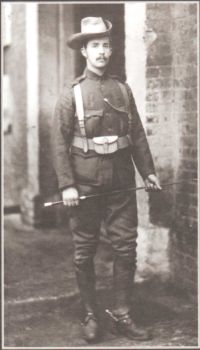
Erskine Childers

Erskine Childers

Summary

Portrait of Erskine Childers Erskine Childers In the Ranks of the C.I.V

The really absorbing things are questions of material welfare—sordid, physical, unromantic details, which touch you at every turn. Shall we camp in time to dry my blankets? Biscuit ration raised from three to three and a half! How can I fill my water-bottle? Rum to-night! Is there time for a snooze at this halt? Dare I take my boots off to-night? Is it going to rain? There are always the thousand little details connected with the care of horses and harness, and all along the ever-present problem of the next meal, and how to make it meet the demands of your hunger.
Source: Gutenberg

Portrait of Erskine Childers Erskine Childers In the Ranks of the C.I.V

A line of veldt-fire is sure to be glowing in the distance, looking like the lights of a sea-side town as seen from the sea. The only sound is of mules shuffling and jingling round the waggons.
The "cook-house" is still the source of rumours, which are wonderfully varied. There is much vague talk now of General Clements and a brigade being connected somehow with our operations. But we know as little of the game we are playing as pawns on the chessboard. Our tea is strong, milkless, and sugarless, but I always go to sleep the instant I lie down, even if I am restless with the cold later.
Source: Gutenberg

Portrait of Erskine Childers Erskine Childers In the Ranks of the C.I.V

The lead-driver has to pick the road and, with one eye on the gun just ahead, to judge a pace which will suit the wheel-driver, who at such moments must have a fairly free hand. All three live always in a fierce glare of criticism from the gunners riding behind, who in their nasty moments are apt to draw abusive comparisons between the relative dangers of shell-fire and riding on a waggon.
Source: Gutenberg

Get perspective with Kwize: daily news enlightened by great literature