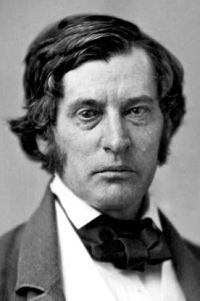
The President of the United States functions as both head of state and government, exercising executive power, leading the military, and influencing domestic and foreign policy. From Theodore Parker’s belief in the presidency’s capacity to elevate humanity to Gerald Stanley Lee’s perspective of the president as a “comptroller of the people’s vision,” writers have long debated its dual role as a leader and symbolic figure.
Carl Schurz highlighted Washington’s example as a moral guide, while Theodore Roosevelt emphasized its immense influence within free institutions. These viewpoints illustrate the presidency as both a powerful institution and a mirror of shifting national values, grounded in constitutional structures and the legacies of its occupants.
 Theodore Parker,
The Collected Works of Theodore Parker
(1863)
Theodore Parker,
The Collected Works of Theodore Parker
(1863)