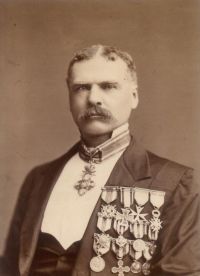
Sir Colin Campbell

Definition and stakes

James Grant,  Laura Everingham; or, The Highlanders of Glen Ora (1866)

“ Over the mantelpiece hung an engraved portrait of Sir Colin Campbell, General of the Highland Division, and a row of enormous stags' antlers and skulls.
A handsome, but elderly man, with grizzled hair, becoming slightly bald, and having an obstinate moustache that despised bandoline and defied all trimming, and having a face browned by every climate under heaven, was seated on one chair, while his spurred heels rested on another.
”
Source: Gutenberg

F. J. Cross,  Beneath the Banner: Being Narratives of Noble Lives and Brave Deeds

“ But now near at hand was Sir Colin Campbell with the army of relief.
It was difficult, nay, almost impossible, to get a trusty messenger through that multitude of fierce and bloodthirsty foes; and yet it was of the utmost importance that Sir Colin should have some one to tell him what was passing within the Residency, and show him the best route by which his troops could approach.
If any man tried to get through and failed, death—or perhaps worse still, horrible torture—was his certain fate. But there was one man who determined to do it, or die in the attempt. His name was Kavanagh.
”
Source: Gutenberg

William Forbes-Mitchell,  Reminiscences of the Great Mutiny 1857-59

“ Just before we started I saw Sir Colin drinking his tea, the same kind as that served out to the men, out of a Ninety-Third soldier's canteen. Writing of the relief of Lucknow, Lady Inglis in her lately-published journal states, under date the 18th of November, 1857, two days after the time of which I write: "Sir Colin Campbell is much liked; he is living now exactly as a private soldier, takes his rations and lies down wherever he can to rest. This the men like, and he is a fine soldier. A Commander-in-Chief just now has indeed no enviable position." ”
Source: Gutenberg

Get perspective with Kwize: daily news enlightened by great literature