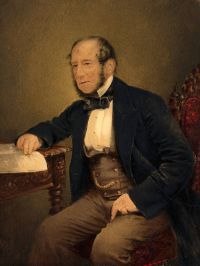
Thomas White

Definition and stakes

William Holden Hutton,  Dictionary of National Biography… (1900)

“ White was a man of sane judgment and genuine piety; he has rarely, if ever, been surpassed among merchants as a benefactor to education and to civic bodies.
There are several portraits of Sir Thomas White, but it is doubtful if any were painted from life. A large picture in the hall of St. John's College is similar to those belonging to the Merchant Taylors' Company, to Leicester (see Coates, Reading, p. 410) , and to nearly all of the towns to which he left benefactions (cf. Hist. MSS. Comm. Reading, p. 206, Lincoln, p. 88) .
”
Source: Wikisource

William Holden Hutton,  Dictionary of National Biography… (1900)

“ Sir Thomas White has frequently been confused (as by Ingram, Memorials of Oxford, St. John's College, p. 5) with a namesake, Sir Thomas White of South Warnborough, Hampshire [cf. art. White, John, 1511–1560] , who was knighted on the same day, and whose wife's name, Agnes, is not uncommonly interchanged with Avicia. The confusion is rendered the more natural from the fact that the White property at South Warnborough eventually passed into the hands of St. John's College, Oxford. ”
Source: Wikisource

1911 Encyclopædia Britannica, Volume 28… (1911)

“ In 1555 White received a licence to found a college at Oxford, which he endowed with lands in the neighbourhood of the city and which, dedicated to the Virgin Mary and St John Baptist, was opened in 1560. Soon after this event Sir Thomas began to lose money, and he was comparatively poor when he died at Oxford on the 12th of February 1567. His later years were mainly spent in Oxford, and he was buried in the chapel of St John's College. ”
Source: Wikisource

Get perspective with Kwize: daily news enlightened by great literature