AI-generated from sources
Beyond the Auditory Wall, Deafness as Absence and Presence
In Brief
- Historical narratives often framed deafness as a profound loss, leading to social isolation and a perceived coarsening of the intellect.
- Deafness fosters unique compensatory senses, particularly heightened visual acuity and the development of rich visual languages like sign language.
- The deaf community functions as a self-sufficient social and cultural force, challenging deficit narratives through shared identity and mutual support.
- The mind's capacity for thought, imagination, and aesthetic appreciation transcends specific sensory inputs, demonstrating a reality independent of perishable senses.
Main authors


The historical and philosophical discourse surrounding deafness has often been dominated by a narrative of profound loss. This perspective frames the condition as an 'impenetrable wall' separating an individual from the vibrant social world of sound, effectively creating a 'dungeon of isolation' [1, 2]. Within this framework, deafness is not merely a sensory absence but a fundamental barrier to nuanced human connection, potentially leading to a coarsening of mind and feeling as complex thoughts struggle to be conveyed beyond a raised voice [3]. This view casts deafness as a tragedy to be overcome, a relentless battle against a debilitating doom that cuts one off from both society and the full appreciation of artistic creations like music . The dominant emotional tone is one of affliction, of a life lived amidst sorrow and struggle, defined primarily by what is missing.
Conversely, this conception of deafness as a pure deficit is challenged by a perspective that sees it as an alternative mode of being, one that cultivates unique perceptual and cognitive strengths. This alternative narrative suggests that when one sensory gateway is barred, others may open wider, allowing for a heightened visual genius or a deeper appreciation for non-auditory forms of communication [9, 13]. The experience of the deaf community can be seen not as one of uniform tragedy, but as a journey from darkness into a unique form of light, fostering self-sufficient communities with their own rich social fabrics [17, 19]. The ultimate philosophical implication, articulated powerfully by thinkers like Helen Keller, is that the 'immaterial mind' is not bound by its perishable senses, allowing the human spirit to access a world of eternal beauty regardless of sensory limitations [21]. This tension—between deafness as a debilitating void and as the foundation for a different, yet complete, way of life—forms the central axis of inquiry.
The Weight of Absence and Isolation
The experience of deafness has historically been characterized by profound social isolation. Harry Best describes it as being surrounded by an 'impenetrable wall' against which the voices of others break in vain, trapping individuals with their social instincts while denying them an outlet . This sense of being cut off from genuine communion with others is echoed in Rupert Hughes's dramatic portrayal of Beethoven's deafness as a 'dungeon of isolation,' a descent into a black fog of silence . The inability to participate effortlessly in the flow of conversation renders the deaf person an outsider, present in body but separated by an invisible yet absolute barrier.
Beyond social exclusion, deafness has been perceived as inflicting a heavy psychological and intellectual toll. Hughes suggests that this particular affliction can breed suspicion and self-loathing, a stark contrast to the placidity often associated with blindness . This internal turmoil is compounded by societal misperceptions. For instance, Nathaniel Hawthorne posited that the physical necessity of speaking in a 'bawl' to be understood prevents the expression of any delicate or fine feeling, leading him to conclude that a deaf person's mind might become 'uncommonly coarse' . This view reduces the individual's inner world to the limitations of their communicative medium, equating sensory lack with a lack of sophistication.
The practical challenges of hearing loss further underscore the deficit model. Even partial deafness can create significant barriers, such as the inability to hear high notes or actors in a theater without being extremely close to the source of the sound [4]. Historically, thinkers like Harriet Martineau argued that deafness from birth was a worse affliction than congenital blindness because it could impede the development of language, the primary tool of the mind [5]. Writing in the 19th century, Edward Burnett Tylor expressed a similar concern, arguing that the loss of hearing and speech could diminish the mind's capacity for 'inward language,' a deficit that no substitute could fully replace without immense effort [6].
Compensatory Senses and Alternative Languages
Challenging the notion that deafness entails cognitive deficiency, a different perspective emphasizes the mind's remarkable adaptability. Proponents of this view argue that reasoning processes are not fundamentally dependent on audible speech or language, observing that uneducated deaf children appear no different in their cognitive functioning from their hearing siblings [7]. In fact, the absence of hearing may even enhance other abilities. The child psychologist William T. Preyer noted that a child born deaf often develops a greater mastery of pantomime and gesture than a hearing child, whose attention is constantly diverted by sound [8]. This suggests a re-routing of cognitive resources rather than a diminishment of them.
This cognitive adaptation is most evident in the development of sophisticated non-auditory communication methods. Thomas Hardy poetically observed that the eyes possess their own 'accents' and that more stories can emerge from pale lips than can be processed by an ear, highlighting the rich expressive potential of visual cues . This capacity is systematically developed through skills like lip-reading, which allows deaf individuals to 'hear' conversations by watching mouths. This skill can even confer an advantage in certain contexts, such as understanding the dialogue in early silent films better than the average viewer [10].
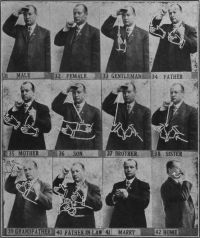
The most comprehensive alternative to spoken language is, of course, sign language. As documented by J. Schuyler Long in the early 20th century, this distinct linguistic system is not merely a tool for basic social interaction but a vehicle for complex thought and cultural participation. Through sign language and interpreters, deaf individuals can fully engage with lectures, plays, and sermons, accessing a world of ideas that would otherwise be closed to them [11]. It is a complete language that enables a full and nuanced intellectual life, independent of the spoken word.
This principle of compensation extends beyond language to a general heightening of other senses. The mind reinterprets sensory inputs, allowing the deaf to become acutely aware of vibration—described by Mary L. Day as the 'father of sound'—and the blind to feel the presence of nearby objects in a way that is analogous to sight [12]. For some, like the artist described by Elizabeth W. Champney, the closure of the auditory 'gateway to the soul' seems to open the gateway of vision wider, fostering a unique 'genius for finding compositions' and discovering pictures in every scene .
The Deaf Community as a Social and Cultural Force
The shared experience of deafness and the reliance on alternative modes of communication naturally lead to the formation of a distinct social group. As Harry Best observed, their condition removes them from the usual avenues of intercourse, causing the deaf to become 'a class apart in the community' [16]. While this separation can be a source of isolation from the hearing world, it also serves as the foundation for a unique and supportive community with its own cultural norms and social structures.
Within this community, deafness is often reframed not as a deficiency but as a different way of being, one with its own unique advantages. Rather than a constant struggle, it can be seen as an escape from the 'unnecessary noises' of the world [14]. This perspective gives rise to the idea that the deaf inhabit 'delectable lands of their own into which we can never stray,' filled with the 'wonderful flowers of silence' [15]. This reframing shifts the focus from loss to the cultivation of a rich inner life grounded in a world that is primarily visual and kinesthetic, a world that hearing people may never fully appreciate.
This sense of shared identity has fueled a collective journey toward social and economic empowerment. The story of the deaf is one of a people who have struggled from 'darkness into the light,' achieving a richness and fullness of living through communal effort and mutual support . This progress is reflected in their significant contributions to society across science, the arts, and industry, as acknowledged in a 1983 proclamation by Ronald Reagan [18]. The community has steadfastly asserted its economic independence, with members functioning as wage-earners on par with the general population and succeeding in a wide range of occupations where their hearing impairment is little to no drawback .
Despite these achievements, the deaf community has also had to contend with societal misperceptions. Well-meaning portrayals that frame their accomplishments as 'wonders' or remarkable feats for people without hearing can be counterproductive. Such accounts, as Best cautions, risk making the deaf appear as a 'peculiar and unlike part of the race,' reinforcing their otherness rather than promoting an understanding of their shared capabilities with the hearing population [20]. The goal is not to be seen as objects of fascination but as equal citizens who ask for no special favors .
The Mind Beyond the Senses
The experience of deafness prompts a profound philosophical inquiry into the nature of consciousness itself, suggesting that the mind operates independently of its sensory inputs. Helen Keller famously argued that deafness and blindness are limitations of the perishable, material body, but they do not exist in the 'immaterial mind,' which she considered the 'real world' . This view finds support in the work of the 18th-century naturalist Buffon, who contended that even if you strip away sight, hearing, and touch, the mind and its capacity for thought would still subsist; it is only the removal of all properties from matter itself that would result in annihilation [27]. The absence of a sense, therefore, need not distort one's intellectual faculties or pervert the inner order of the mind [26].
The mind's creative power is vividly demonstrated by its ability to bridge sensory gaps through imagination. As Maria Montessori observed, individuals who have been blind from birth may imagine colors by analogizing them to sounds—conceiving of red as the blare of a trumpet, for example [28]. Conversely, deaf individuals reading descriptions of music might imagine scenes of classic visual beauty. This cross-modal mapping reveals that the imagination is not a passive recipient of sensory data but an active force that translates and reconstructs reality, creating a coherent inner world even from incomplete information.
This plasticity of perception challenges the idea that certain art forms are exclusively tied to a single sense. Music, often considered a purely auditory art, can be understood more abstractly. De Witt H. Parker described it as a world of 'pure feeling' that supplies the emotional tone of events without needing to represent the events themselves [22]. H. Ernest Hunt took this further, defining sound as vibration and noting that its existence for any individual depends on their capacity to perceive it [25]. This implies that the 'message and meaning' of music might exist in a vibrational form accessible to those who are keenly attuned to it, even without hearing.
Ultimately, this leads to the concept of a universal aesthetic, where all arts aspire to a shared ideal that transcends their specific mediums. Friedrich Schiller envisioned a point of perfection where music would attain the calm power of a statue, and plastic art would move the soul with the immediacy of music [23]. Walter Pater identified this ideal state in music's perfect fusion of form and matter, a condition toward which all other arts constantly strive [24]. This notion of a deep, underlying harmony—a 'rhythm of space divisions' and 'harmony of colours' that creates a beautiful whole without any 'discordant notes'—suggests that the principles of art and beauty are accessible to the mind through various sensory pathways, not just the ear [29].
The journey through the varied perspectives on deafness reveals a profound evolution in understanding. It begins with the visceral depiction of a life confined within an 'impenetrable wall,' marked by social isolation and the perceived degradation of nuanced thought . This deficit-focused model, which highlights the psychological burdens of suspicion and self-abhorrence, gives way to a more nuanced appreciation of human adaptability . The development of compensatory perceptual skills, the rich visual language of gesture and lip-reading, and the comprehensive system of sign language demonstrate that the absence of one sense can amplify the acuity of others . This leads to the emergence of a resilient and self-sufficient community that redefines its condition not as a lack, but as the basis for a distinct and valuable culture .
Ultimately, the discourse on deafness transcends its immediate subject to ask fundamental questions about the nature of the human mind and aesthetic experience. The capacity of the intellect to function and thrive independently of its sensory apparatus suggests that consciousness is more abstract and adaptable than is commonly assumed . The mind's ability to translate sound into color, or music into form, points toward a universal grammar of beauty that is not beholden to any single sensory channel . The experience of living without sound, therefore, becomes a powerful testament to the mind's ability to construct a complete and meaningful reality, forcing us to reconsider the very boundaries between our senses, our thoughts, and our connection to the world.