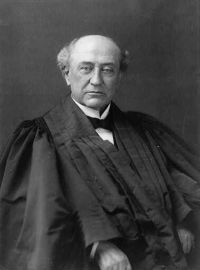
Arkansas Supreme Court; George Rose Smith; Edward F. McFaddin

Biographical details

Arkansas Supreme Court; George Rose Smith; Edward F. McFaddin Alford v. State (1954)

Our theory is simply that a finding of guilty should rest upon proof, beyond a reasonable doubt, that the accused committed the exact offense for which he is being tried. We do not permit the State to bolster its appeal to the jury by proof of prior convictions, with their conclusive presumption of verity, and still less is there reason to allow the jury to be prejudiced by mere accusations of earlier misconduct on the part of the defendant.
Source: Wikisource

Arkansas Supreme Court; George Rose Smith; Edward F. McFaddin Alford v. State (1954)

No one doubts the fundamental rule of exclusion, which forbids the prosecution from proving the commission of one crime by proof of the commission of another. The State is not permitted to adduce evidence of other offenses for the purpose of persuading the jury that the accused is a criminal and is therefore likely to be guilty of the charge under investigation. In short, proof of other crimes is never admitted when its only relevancy is to show that the prisoner is a man of bad character, addicted to crime.
Source: Wikisource

Arkansas Supreme Court; George Rose Smith; Edward F. McFaddin Alford v. State (1954)

Austin's testimony to the issue of intent. If her evidence had no permissible relevancy to that issue, and we think it had none, then the jury could obey the instruction only by disregarding the evidence altogether—a result that is more surely accomplished by excluding the testimony in the first place. It is not without regret that we send this cause back for a new trial. But this issue goes to the very heart of fairness and justice in criminal trials; we cannot conscientiously sustain a verdict that may have been influenced by such prejudicial testimony.
Source: Wikisource

Get perspective with Kwize: daily news enlightened by great literature