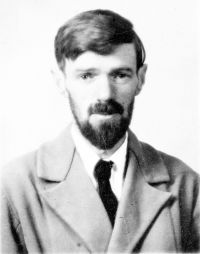
David Herbert Lawrence

Biographical details

Portrait of David Herbert Lawrence David Herbert Lawrence The Trespasser (1912)

Often, when all the world was hostile, he had found her full of love, he had hidden his face against her, she had gone to sleep in his arms, she had been like a piece of apple-blossom in his arms. If she should come to him now—his heart halted again in suspense—he knew not what he would do. It would open, perhaps, the tumour of his sickness. He was quivering too fast with suspense to know what he feared, or wanted, or hoped.
“Gwen!” called Vera, wondering why she did not return. “Gwen!”
“Yes,” answered the child, and slowly Siegmund saw her feet lifted, hesitate, move, then turn away.
Source: Wikisource

Portrait of David Herbert Lawrence David Herbert Lawrence Tortoises (1921)

Over the clods of the autumn, wind-chilled sun-
shine,
Young gayety.
Does he look for a companion?
No, no, don't think it.
He doesn't know he is alone;
Isolation is his birthright,
This atom.
To row forward, and reach himself tall on spiny
toes,
To travel, to burrow into a little loose earth,
afraid of the night,
To crop a little substance,
To move, and to be quite sure that he is moving:
Basta!
To be a tortoise!
Think of it, in a garden of inert clods
A brisk, brindled little tortoise, all to himself—
Croesus!
Source: Wikisource

Portrait of David Herbert Lawrence David Herbert Lawrence The Trespasser (1912)

Helena did not know. Nor did she know what he meant. But she felt something of the harmony.
“Whatever I have or haven’t from now,” he continued, “the darkness is a sort of mother, and the moon a sister, and the stars children, and sometimes the sea is a brother: and there’s a family in one house, you see.”
“And I, Siegmund?” she said softly, taking him in all seriousness. She looked up at him piteously. He saw the silver of tears among the moonlit ivory of her face. His heart tightened with tenderness, and he laughed, then bent to kiss her.
Source: Wikisource

Get perspective with Kwize: daily news enlightened by great literature