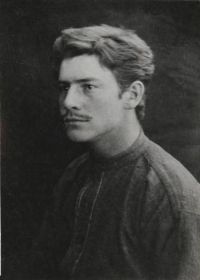
E. L. Kolb

Biographical details

E. L. Kolb Through the Grand Canyon from Wyoming to Mexico

In a few swiftly passing hours we had made a six-thousand foot descent from the plateau with its fir and aspen-covered mountain, its cedar and piñon-clothed foot-hills, and its extensive forests of yellow pine. Crimson and yellow-flowered cactus, sage and chaparral, succeeded the pines. The cool mountains had given way to burned-out, umber-coloured hills, rock-ribbed arroyos, and seemingly endless desert; and the sun was growing hotter every minute.
If the heat continued to increase, I doubted if I would care to take a half-planned Colorado River trip down to the Gulf.
Source: Gutenberg

E. L. Kolb Through the Grand Canyon from Wyoming to Mexico

Gems of sunlight sparkled on its bosom and scintillated in the ripples left behind by the oars. When seated with our backs to the strongest light, and when glancing along the top of such a pool instead of into it, the mirror-like surface gave way to a peculiar purplish tone which seemed to cover the pool, so that one would forget it was roily water, and saw only the iridescent beauty of a mountain stream.
Source: Gutenberg

E. L. Kolb Through the Grand Canyon from Wyoming to Mexico

It is a never ending source of wonder, to those unacquainted with the semi-arid country, how these animals can exist in a land which, to them, seems utterly destitute and barren. To many such, a meadow carpeted with blue grass or timothy is the only pasture on which grazing horses or grazing cattle can exist; the dried-out looking tufts of bunch-grass, scattered here and there or sheltered at the roots of the sage, mean nothing; the grama-grass hidden in the grease-wood is unnoticed or mistaken for a weed.
But if the land was bare of verdure, the rock saved it from being monotonous.
Source: Gutenberg

Get perspective with Kwize: daily news enlightened by great literature