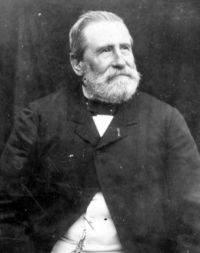
Gaston de Saporta

Biographical details

Portrait of Gaston de Saporta Gaston de Saporta,  Popular Science Monthly (1883)

“ THE carboniferous formation represents the most wonderful episode in the history of our globe. It gives us an impression comparable in strangeness to that produced by those wonderful civilizations which blossomed out so suddenly and so splendidly in the infancy of mankind. Only a rare concurrence of circumstances could have brought on the expansion of plant-growth which characterized its epoch. ”
Source: Wikisource

Portrait of Gaston de Saporta Gaston de Saporta,  Popular Science Monthly (1883)

“ The changes, immersions, and emersions have never been anything but partial and successive, while the skeletons of the continents go back to the most remote ages. There have always been a Europe, an Asia, an America, and Arctic lands. We know certainly that there have always been around the Arctic pole extensive territories, if not continents, long the home of the same plants as the rest of the globe, and that, beginning with an epoch that corresponds with the end of the Jurassic, the climate, at first as warm there as elsewhere, has tended gradually to become colder. ”
Source: Wikisource

Portrait of Gaston de Saporta Gaston de Saporta,  Popular Science Monthly (1883)

“ All that we have are the marks that man has left on Nature, who, in her incessant action burying these marks under accumulations of successive strata, gives us a kind of relative chronology. It is now admitted by science that the life of man crosses the whole Quaternary period, and if we can measure the duration of that period we shall be able to fix approximately the age of our race. ”
Source: Wikisource

Get perspective with Kwize: daily news enlightened by great literature