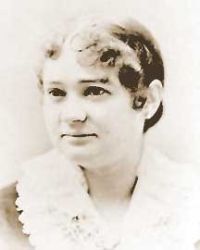
Idah Meacham Strobridge

Biographical details

Portrait of Idah Meacham Strobridge Idah Meacham Strobridge The Loom of the Desert (1907)

All day, all night, the stamps kept up their ceaseless monotone. The weather-worn mill and drab adobe houses had stood there, year after year, through the heat of summer days, when the sun blistered and burned the whole valley, and in winter, when the winds of the desert moaned and wailed at the windows.
Today the air is quiet, save for the tiny whirlwinds that, running over the tailings below the mill, have caught up the fine powder and carried bits of it away with them, a white cloud, as they went. The sun, too, is shining painfully bright and burning.
Source: Gutenberg

Portrait of Idah Meacham Strobridge Idah Meacham Strobridge The Loom of the Desert (1907)

Yet the refined and aesthetic side of Alfred Baird’s nature—and there was such—much have met with some pretty severe shocks during a twelvemonth’s close companionship. Too indolent to work to support himself, he bore (he felt, heroically) any mortification he was subjected to, and was content in his degradation. But the woman herself was intensely happy; happier than, in all her dreary life, she had ever dreamed that mortals could be. She was in love with the beautiful new world, which was like a dream of fairy-land after her sordid life in the desolate valley.
Source: Gutenberg

Portrait of Idah Meacham Strobridge Idah Meacham Strobridge The Loom of the Desert (1907)

And Topo, the little cow-horse trained to such work, wheeled at the touch of the spur as the turns of the rope fastened themselves about the horn of the saddle, and the man—furrowing the hoof-powdered dust of the corral—was dragged to the heels of the wild stallion. Lucas, glancing hastily at the face, earth-scraped and smeared and the full lips that were bleeding under their fringe of gold, saw that—though insensible for a moment from the quick jerk given the rope—the blue eyes of the man were opening. Lucas swung himself out of the saddle—leaving Topo to hold taut the riata.
Source: Gutenberg

Get perspective with Kwize: daily news enlightened by great literature