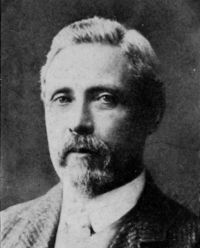
John George Clark Anderson

Biographical details

John George Clark Anderson,  1911 Encyclopædia Britannica (1911)

“ Hereafter the simple name Pontus without qualification was regularly employed to denote the half of this dual province, especially by Romans and people speaking from the Roman point of view; it is so used almost always in the New Testament. But it was also frequently used to denote (in whole or part) that portion of the old Mithradatic kingdom which lay between the Halys (roughly) and the borders of Colchis, Lesser Armenia, Cappadocia and Galatia-the region properly designated by the title “Cappadocia towards the Pontus,” which was always the nucleus of the Pontic kingdom. ”
Source: Wikisource

John George Clark Anderson,  1911 Encyclopædia Britannica (1911)

“ With the decline of their warlike vigour they began gradually to mix with the natives and to adopt at least their religion: the amalgamation was accelerated under Roman influence and ultimately became as complete as that of the Normans with the Saxons in England, but they gave to the mixed race a distinctive tone and spirit, and long retained their national characteristics and social customs, as well as their language (which continued in use, side by side with Greek, in the 4th century after Christ) . ”
Source: Wikisource

John George Clark Anderson,  1911 Encyclopædia Britannica, Volume 21… (1911)

“ Like Ancyra and Tavium, Pessinus was Romanized first and Hellenized afterwards. Only about A.D. 165 did Hellenic ways and modes of thought begin to be assumed; before that we find a deep substratum of Celtic feeling and ways, on which Roman elements had been superimposed without filtering through a Hellenic medium. Christianity was introduced late; it cannot be traced before the 4th century. ”
Source: Wikisource

Get perspective with Kwize: daily news enlightened by great literature