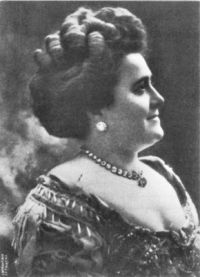
“ I allude to the fact that the singer is necessarily a reproductive artist—one whose business it is from the nature of the case to reproduce and interpret the music of others.This imposes a duty and an obligation which should never be lost sight of. A singer has not only his own reputation to consider, but also that of the composer whose music he interprets, and for this reason alone, therefore, he can never take his art too seriously. ”
Luisa Tetrazzini
Biographical details

Luisa Tetrazzini (1871–1940), an Italian coloratura soprano of international acclaim, enchanted audiences with her remarkable vocal dexterity and range, performing across Europe, America, and South America from the 1890s to the 1920s.
In addition to her operatic successes, she wrote How to Sing (1923) and My Life of Song (1921), in which she stressed the importance of consistent daily practice, the gramophone's value in vocal training, and the need for a thorough grasp of dramatic context. Her influence continues through her recordings and teaching methods, which remain essential to vocal artistry.
Quotes by Luisa Tetrazzini
“ Beyond a doubt the gramophone should be the guide, philosopher, and friend—the most trusted and most competent aid and coadjutor—not only to every student, but also to every teacher of the present day.Of course, the pupil is only human and often reluctant to believe that there are grave faults in his voice. Whilst others can detect his mistakes, the pupil cannot listen intelligently to his own faulty emission while singing. ”
“ If he happens to be studying some particular rôle he can be “coached” in this most practical and unrivalled manner by all the greatest artists of the day. He can take a particular aria and hear it sung by Caruso again and again until he is familiar with every detail of his rendering—can note his breathing, his phrasing, and every other detail in a manner which would be quite impossible by any other means. ”
