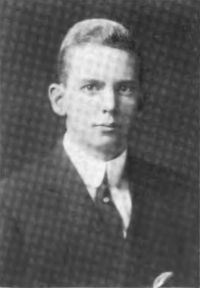
Robert L. Tyler

Biographical details

Robert L. Tyler,  Oregon Historical Quarterly, Volume 55…

“ FOR OVER a decade the Industrial Workers of the World preached its gospel of the "One Big Union" and the "General Strike" from corner soap boxes, sang its irreverent songs, badgered police, and fought pitched battles with vigilantes. With vaunting ambition it planned to incorporate all workers, but in practice it attracted mostly the seasonal laborers of Western orchards and farms, logging camps, and mines. The story of the I.W.W. is part of the history of labor in the post frontier West, and many scenes of the drama are set in the Pacific Northwest. ”
Source: Wikisource

Robert L. Tyler,  Oregon Historical Quarterly, Volume 55…

“ When the Union's inspiration through the workers' blood shall run, There can be no power greater anywhere beneath the sun. 2. I.W.W. Songs to Fan the Flames of Discontent (Chicago, I.W.W., 1945) .
Yet what force on earth is weaker than the fee of one? But the union makes us strong! Chorus Solidarity forever! Solidarity forever! Solidarity forever! For the Union makes us strong. Wobblies sang many of their songs to the tunes of familiar hymns, a practice that undoubtedly contributed to their un savory reputation.
”
Source: Wikisource

Robert L. Tyler,  Oregon Historical Quarterly, Volume 55…

“ The somewhat feudal organization of the community perhaps made it inevitable, and the Shingle Weavers' Union, a militant A.F.L. union, had already aroused the passions of both the workers and the local aristocracy. Everett, a port city on Puget Sound about thirty miles north of Seattle, boasted a population of 35,000 in 1916, and its life depended almost completely upon its lumber and shingle mills. Lumbermen controlled most of the economic resources of the city, its stores, banks, and real estate ”
Source: Wikisource

Get perspective with Kwize: daily news enlightened by great literature