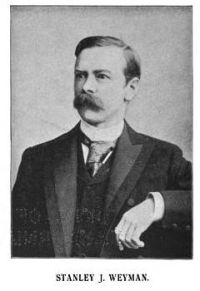
Stanley J. Weyman

Biographical details

Portrait of Stanley J. Weyman Stanley J. Weyman Count Hannibal (1901)

When she rose he thanked her; and then the devil in the man, or the Nemesis he had provoked when he took her by force from another—the Nemesis of jealousy, drove him to spoil all.
“And for whose sake, Madame?” he added, with a jeer; “mine or M. de Tignonville’s?” And with a glance between jest and earnest, he tried to read her thoughts.
She winced as if he had indeed struck her, and the hot colour fled her cheeks.
“For his sake!” she said, with a shiver of pain. “That his life may be spared!” And she stood back humbly, like a beaten dog.
Source: Wikisource

Portrait of Stanley J. Weyman Stanley J. Weyman Flore (1896)

In silence, which neither again broke by so much as a movement, we waited gazing, while the light in the mean hovel grew and grew, and minute by minute brought out more closely the other's features.
At length I knew him, and almost at the same moment he recognised me, and, uttering an oath of rage, rose up as if to spring at my throat. But either because I did not recoil—being too deep set in the hay to move—or for some other reason, he only shook his claw-like fingers at me, and held off. "Where is it, you dog?" he cried, finding his voice with an effort.
Source: Wikisource

Portrait of Stanley J. Weyman Stanley J. Weyman Under the Red Robe — Chapter 10 (1895)

We seemed to be across the meadow and in the wood in a moment. There, instead of keeping along the common path, I boldly singled out—my senses seemed preternaturally keen—the smaller trail by which Clon had brought us, and ran unfalteringly, avoiding logs and pitfalls as by instinct, and following all its turns and twists, until we came to the back of the inn, and could hear the murmur of subdued voices in the village street, the sharp low word of command, and the clink of weapons; and could see over and between the houses the dull glare of lanthorns and torches.
Source: Wikisource

Get perspective with Kwize: daily news enlightened by great literature