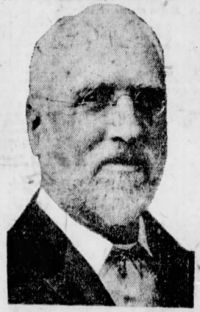
Stewart D. F. Salmond and Alexander J. Grieve

Biographical details

Stewart D. F. Salmond and Alexander J. Grieve 1911 Encyclopædia Britannica, Volume 16… (1911)

Platonic too is the doctrine of the divine architect who seeks to realize in the visible universe the archetypes already formed in his mind. Philo was thus able to make the Logos theory a bridge between Judaism and Greek philosophy. It preserved the monotheistic idea yet afforded a description of the Divine activity in terms of Hellenic thought; the Word of the Old Testament is one with the λόγος of the Stoics. And thus in Philo’s conception the Logos is much more than “the principle of reason, informing the infinite variety of things, and so creating the World-Order”
Source: Wikisource

Stewart D. F. Salmond and Alexander J. Grieve 1911 Encyclopædia Britannica, Volume 16… (1911)

There is at the same time the special doctrine of the λόγος σπερματικός, the seminal Logos, or the law of generation in the world, the principle of the active reason working in dead matter. This parts into λόγοι σπερματικοί, which are akin, not to the Platonic ideas, but rather to the λόγοι ἔνυλοι of Aristotle. In man, too, there is a Logos which is his characteristic possession, and which is ἐνδιάθετος, as long as it is a thought resident within his breast, but προφορικός when it is expressed as a word.
Source: Wikisource

Stewart D. F. Salmond and Alexander J. Grieve 1911 Encyclopædia Britannica, Volume 16… (1911)

Instead of the once powerful confidence in the immediate presence of God there grew up a mass of speculation regarding on the one hand the distant future, on the other the distant past. Various attempts were made to bridge the gulf between God and man, including the angels, and a number of other hybrid forms of which it is hard to say whether they are personal beings or abstractions.
Source: Wikisource

Get perspective with Kwize: daily news enlightened by great literature