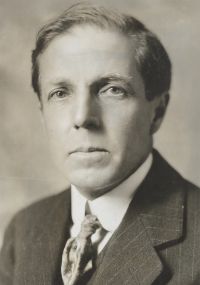
Vernon Lyman Kellogg

Biographical details

Portrait of Vernon Lyman Kellogg Vernon Lyman Kellogg Popular Science Monthly (1912)

Most of these volcanoes are dead, but some are alive, as Mauna Loa on Hawaii and the recently reopened and still flaming volcano on Savaii of the Samoan group. But practically every volcano island has its coral reefs, either fringing or barrier or both. Like a ring of Saturn the flat-topped band encircles the volcano's waist at the ocean surface, and in the shallow waters and innumerable pools on the reef the naturalist finds a rich collecting ground.
Source: Wikisource

Portrait of Vernon Lyman Kellogg Vernon Lyman Kellogg Popular Science Monthly (1912)

The most extraordinary, as well as the most famous, worm of the Samoan reefs is that curious creature called the palolo, which with a certain phase of the moon in November of each year appears in myriads in the shallow reef waters and is gathered with feverish haste by the natives as the choicest food of the whole year's finding. To be accurate, they are not the worms themselves which thus appear, but only certain parts of the worm body, the egg-producing parts, which break off from the rest of the worm, lying in crevices in the reef far below the water's surface.
Source: Wikisource

Portrait of Vernon Lyman Kellogg Vernon Lyman Kellogg Popular Science Monthly (1912)

Of slender-rayed brittle stars there are brown and green and mottled sorts, some with white cross bands on each arm, and all with the fragile arms breaking away with the least roughness in handling. Often merely the contact with the preserving fluids seems to be sufficient for a general epidemic of arm-shattering. Among the sea urchins a kind with very slender, long, almost needle-like spines is abundant. These spines are not only sharp, but stinging, and often a warning tingle told the exploring hand in crevice or pool bottom of the presence of this well-protected little urchin.
Source: Wikisource

Get perspective with Kwize: daily news enlightened by great literature