Summary

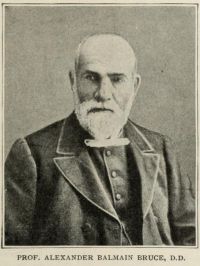
Portrait of Alexander Balmain Bruce Alexander Balmain Bruce The Teaching of Christ in the Gospels of Matthew… (1895)

The doctrine of the divine Father says to all who have ears to hear: Let it never be forgotten that every man even at the lowest has that in him which has inestimable value for God; therefore let no man despair of himself, and let no man in pride despise his degraded brothers. But Jesus did not leave so important a truth to be a matter of logical inference from another truth. He expressly affirmed man's absolute infinite significance.
Source: Wikisource

Portrait of Alexander Balmain Bruce Alexander Balmain Bruce The Teaching of Christ in the Gospels of Matthew… (1895)

The body of the discourse is really a portrayal in a series of tableaus of filial righteousness. The artist has employed for his purpose the method of contrast, using the righteousness in vogue, that of the scribes and Pharisees, as a foil to show forth the beauty of the true moral ideal. Jesus had never, like the apostle Paul, been a disciple of the scribes, and the fact is of much significance in connection with the difference perceptible between his conception of righteousness and that of the apostle.
Source: Wikisource

Portrait of Alexander Balmain Bruce Alexander Balmain Bruce The Teaching of Christ in the Gospels of Matthew… (1895)

Seeing then, that the kingdom is the kingdom of the Father, therefore, a kingdom of love, it may be inferred that the righteousness of the kingdom, in the conception of Jesus, is, to begin with, a righteousness of trustful surrender to the loving kindness of the Father in heaven. It is not a legal righteousness as between two persons one of whom makes a demand which the other strives to comply with. It is on man's part towards God trust in his benignant grace.
Source: Wikisource

Get perspective with Kwize: daily news enlightened by great literature