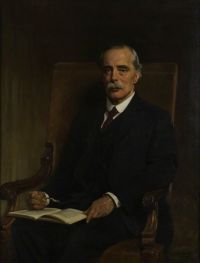
Alfred William Pollard

Alfred William Pollard

Summary

Portrait of Alfred William Pollard Alfred William Pollard 1911 Encyclopædia Britannica (1911)

No doubt the minuteness with which it is possible to make an old book yield up its secrets has encouraged students to pursue the game for its own sake without any great consideration of practical utility, but the materials which have thus been made available for the student of European culture are far from insignificant. The competition among the 15th-century printers was very great and they clearly sent to press every book for which they could hope for a sale, undaunted by its bulk.
Source: Wikisource

Portrait of Alfred William Pollard Alfred William Pollard 1911 Encyclopædia Britannica (1911)

In any attempt to estimate the extent to which the incunabula still in existence represent the total output of the 15th-century presses, a sharp distinction must be drawn between the weightier and the more ephemeral literature. Owing to the great religious and intellectual upheaval in the 16th century much of the literature previously current went out of date, while the cumbrous early editions of books still read were superseded by handier ones.
Source: Wikisource

Portrait of Alfred William Pollard Alfred William Pollard 1911 Encyclopædia Britannica (1911)

POLYGLOTT (Gr. πολύς, many, and γλῶττα, tongue) , the term for a book which contains side by side versions of the same text in several different languages; the most important polyglot ts are editions of the Bible, or its parts, in which the Hebrew and Greek originals are exhibited along with the great historical versions, which are of value for the history of the text and its interpretation.
Source: Wikisource

Get perspective with Kwize: daily news enlightened by great literature