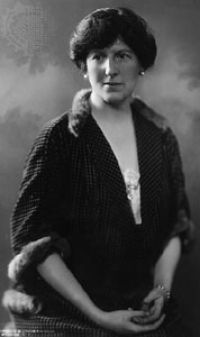
Alice Duer Miller

Alice Duer Miller

Summary

Portrait of Alice Duer Miller Alice Duer Miller The Charm School (1919)

Austin cleared his throat. "How does Elise seem?" he inquired.
"Oh, the way girls do after they've been home for holidays," answered Miss Hayes, crossly. "If I had my way, children should never be allowed to go back to the parents. She looks pale and listless. All these parties and theaters—so silly."
Austin was silent; human beings were pitiful creatures, he thought. Miss Curtis protested. "You ought not to talk that way about parents, Eleanor," she said. "It would ruin the school if any of them heard you. But I must confess, Elise does seem to be in a curious state of mind.
Source: Wikisource

Portrait of Alice Duer Miller Alice Duer Miller The Charm School (1919)

Austin wrenched away his eyes and managed to go on with what he was saying, just as if nothing momentous had happened.
But, he went on to say, there was one point in which it seemed to him all schools failed in their duty. It was the duty of a school not only to train the mind, but to fit for life—to make its pupils happy, useful, well-developed people—in other words, to fit them not only for intellectual achievements, but for their human relations.
And here, with something of a bound, he passed on to the question of charm. What was charm? (The whole school sat up.)
Source: Wikisource

Portrait of Alice Duer Miller Alice Duer Miller The Charm School (1919)

Miss Hayes regarded him thoughtfully. "Now who can that be?" she said. "It's very unlike Elise to be a good correspondent."
"Oh, what do we know about them, when they can deceive us so? Elise! I shall never get over it," wailed Miss Curtis.
"I am inclined to regard this other man as the more serious of the two," said Miss Hayes, her eyes still fixed on Austin.
"Two!" cried Miss Curtis. "Oh, it's disgusting—degrading. I feel as if I should have to give up my work.
Source: Wikisource

Get perspective with Kwize: daily news enlightened by great literature