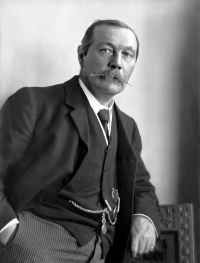
Arthur Conan Doyle

Arthur Conan Doyle

Summary

Portrait of Arthur Conan Doyle Arthur Conan Doyle The War in South Africa — Chapter III (1902)

On August 15, at a time when the negotiations had already assumed a very serious phase, after the failure of the Bloemfontein Conference and the despatch of Sir Alfred Milner, the British forces in South Africa were absolutely and absurdly inadequate for the purpose of the defence of our own frontier. Surely such a fact must open the eyes of those who, in spite of all the evidence, persist that the war was forced on by the British. A statesman who forces on a war usually prepares for a war, and this is exactly what Mr. Kruger did and the British authorities did not.
Source: Wikisource

Portrait of Arthur Conan Doyle Arthur Conan Doyle The War in South Africa — Chapter III (1902)

Evidently for a war with Great Britain, and not for a defensive war. It is not in a defensive war that a State provides sufficient rifles to arm every man of Dutch blood in the whole of South Africa. No British reinforcements had been sent during the years that the Transvaal was obviously preparing for a struggle. In that one eloquent fact lies a complete proof as to which side forced on a war, and which side desired to avoid one.
Source: Wikisource

Portrait of Arthur Conan Doyle Arthur Conan Doyle The War in South Africa — Chapter III (1902)

It is difficult to imagine how a state of unrest and insecurity, to say nothing of a state of war, can ever be to the advantage of capital, and surely it is obvious that if some arch-schemer were using the grievances of the Uitlanders for his own ends the best way to checkmate him would be to remove those grievances. The suspicion, however, did exist among those who like to ignore the obvious and magnify the remote, and throughout the negotiations the hand of Great Britain was weakened, as her adversary had doubtless calculated that it would be, by an earnest but fussy and faddy minority.
Source: Wikisource

Get perspective with Kwize: daily news enlightened by great literature