Summary

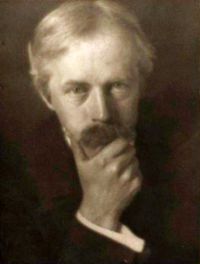
Portrait of Arthur Symons Arthur Symons 1911 Encyclopædia Britannica, Volume 12… (1911)

In his feeling for nature, curiosity sometimes seems to broaden into a more intimate communion. The heath, the village with its peasants, the change of every hour among the fields and on the roads of that English countryside which he has made his own—the Dorsetshire and Wiltshire “Wessex”—mean more to him, in a sense, than even the spectacle of man and woman in their blind and painful and absorbing struggle for existence. His knowledge of woman confirms him in a suspension of judgment; his knowledge of nature brings him nearer to the unchanging and consoling element in the world.
Source: Wikisource

Portrait of Arthur Symons Arthur Symons 1911 Encyclopædia Britannica, Volume 12… (1911)

All the entertainment which he gets out of life comes to him from his contemplation of the peasant, as himself a rooted part of the earth, translating the dumbness of the fields into humour. His peasants have been compared with Shakespeare’s; he has the Shakespearean sense of their placid vegetation by the side of hurrying animal life, to which they act the part of chorus, with an unconscious wisdom in their close, narrow and undistracted view of things. The order of merit was conferred upon Mr Hardy in July 1910.
Source: Wikisource

Portrait of Arthur Symons Arthur Symons 1911 Encyclopædia Britannica, Volume 12… (1911)

In all his work Mr Hardy is concerned with one thing, seen under two aspects; not civilization, nor manners, but the principle of life itself, invisibly realized in humanity as sex, seen visibly in the world as what we call nature. He is a fatalist, perhaps rather a determinist, and he studies the workings of fate or law (ruling through inexorable moods or humours) , in the chief vivifying and disturbing influence in life, women. His view of women is more French than English
Source: Wikisource

Get perspective with Kwize: daily news enlightened by great literature