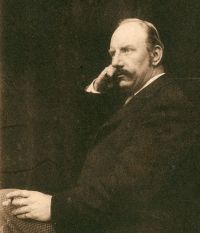
Bernard Barham Woodward

Bernard Barham Woodward

Summary

Portrait of Bernard Barham Woodward Bernard Barham Woodward Dictionary of National Biography (1901)

A keen love of natural history, inherited from his father and fostered at his schools, led him to associate himself with the many eminent naturalists of his city, where he lectured on botany at the Durham College of Medicine. He early devoted special attention to the Foraminifera, on which he became the leading authority, his labours on this subject culminating in the 'Report on the Foraminifera collected by H.M.S. Challenger' (London, 1884, 2 vols. 4to) , still the foremost work on this group of animals.
Source: Wikisource

Portrait of Bernard Barham Woodward Bernard Barham Woodward Dictionary of National Biography (1901)

In 1874, on the foundation of the Strickland curatorship of ornithology in the university of Cambridge, Salvin accepted the post and filled it till 1882, when, having succeeded to his father's property, he removed to Hawksfold, near Farnhurst, Sussex. There he died from an affection of the heart on 1 June 1898. He became a fellow of the Zoological Society in 1860, of the Linnean Society in 1864, of the Royal Society in 1873, frequently serving on their councils; he joined the Royal Geographical Society in 1883, and was also a fellow of the Entomological Society.
Source: Wikisource

Portrait of Bernard Barham Woodward Bernard Barham Woodward Dictionary of National Biography (1901)

Salvin's opinion was widely sought by his fellow naturalists on account of the soundness of his advice and the breadth of his scientific views; his knowledge in all branches of his favourite science was extensive, though his attention was more particularly directed to the birds of tropical America, on which he was an acknowledged authority, and to the Lepidoptera Rhopalocera among insects.
Source: Wikisource

Get perspective with Kwize: daily news enlightened by great literature