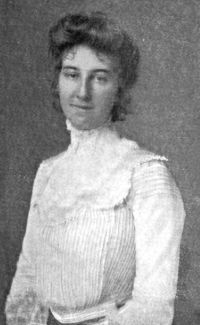
Bertha Runkle

Bertha Runkle

../../ (1873)

Summary

Portrait of Bertha Runkle Bertha Runkle,  ../../ (1873)

“ Talking about games reminds me that I started to tell about the children, and then forgot them. One thing that seems queer to us foreigners is that even the tiny babies are dressed just like the grown people, in long kimonos or loose gowns lapped over in the front, and held together by the wide sash called an obi. But such pretty gay kimonos, covered with flowers or birds or butterflies, tied with sashes of red or pink or yellow or light green!
A streetful of children looks like a walking flower-bed. The streets are always full of children, too.
”
Source: Wikisource

Portrait of Bertha Runkle Bertha Runkle,  ../../ (1873)

“ Each fish belongs to some particular boy, and the carp is chosen because it is a big, strong fish, and not only can swim against the most rapid currents, but in its eagerness to get upstream will leap straight up waterfalls. The gold ball means a treasure, which the carp, leaping and struggling, buffeted by the wind, is forever trying to reach. And the whole thing means that the boy, when he ’s a man, will have to battle his way as the sturdy carp struggles up the river. ”
Source: Wikisource

Portrait of Bertha Runkle Bertha Runkle,  ../../ (1873)

“ You could draw the swords out of their scabbards just like real ones, and they were as sharp as they could be. Well, for about a week all Japan is one grand dolls’ tea-party! And then the festival is over, and all the best dolls, even the presents to the little girl, are put carefully away, never to be even looked at for a whole year. I don’t see how the little Japanese girls can bear that part of it.
Then at the first of May comes the boys’ festival—the Fish Festival, it is called. Every family that ’s lucky enough to have a boy puts up a flagpole in the dooryard
”
Source: Wikisource

Get perspective with Kwize: daily news enlightened by great literature