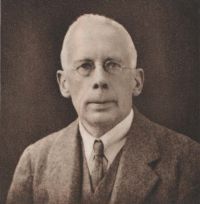
Campbell Dodgson

Campbell Dodgson

Summary

Portrait of Campbell Dodgson Campbell Dodgson Contemporary English woodcuts (1922)

This general statement about nineteenth century engraving admits of certain exceptions. Originality breaks out now and again, whether in the humbler form of broadsides and advertisements and illustrations to chap-books, ballads, and children's story books, or in the work of those rare artists who chose to learn the craft of wood-engraving for themselves, and engrave their own designs without employing a professional hand as interpreter.
Source: Wikisource

Portrait of Campbell Dodgson Campbell Dodgson Contemporary English woodcuts (1922)

Miss Gribble and Miss Pilkington are among the other women artists who practise wood engraving with zeal and success, the former is now turning her attention to book illustration, in which English engravers of the modern school have hitherto achieved smaller results than their contemporaries in France.
All these artists alike, however diverse their vision, their taste or their accomplishment may be, use the wood block and the graver or knife in a strictly orthodox manner as the medium and tools with which to express themselves directly. They cut their lines or spaces as they go on
Source: Wikisource

Portrait of Campbell Dodgson Campbell Dodgson Contemporary English woodcuts (1922)

About the practice in the Latin countries at this period we are less well informed, Italian and French woodcuts being much more rarely signed than the German, Swiss and Dutch. We seldom know the names of the artists who designed the book illustrations; but in Italy, at least, we know that it was a very general practice for drawings and, later on, even pictures, to be reproduced by professional woodcutters.
That was the case also in the seventeenth century, when wood-engraving enjoyed more favour in the Low Countries than elsewhere.
Source: Wikisource

Get perspective with Kwize: daily news enlightened by great literature