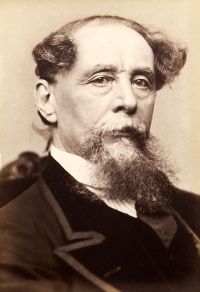
Charles Dickens

Charles Dickens

Summary

Portrait of Charles Dickens Charles Dickens,  Barnaby Rudge — Chapter 62 (1841)

“ His attention was suddenly attracted by a clanking sound—he knew what it was, for he had startled himself by making the same noise in walking to the door. Presently a voice began to sing, and he saw the shadow of a figure on the pavement. It stopped—was silent all at once, as though the person for a moment had forgotten where he was, but soon remembered—and so, with the same clanking noise, the shadow disappeared. ”
Source: Wikisource

Portrait of Charles Dickens Charles Dickens,  Barnaby Rudge — Chapter 62 (1841)

“ In company, in solitude, on land, on shipboard; sometimes leaving me alone for months, and sometimes always with me. I have seen him, at sea, come gliding in the dead of night along the bright reflection of the moon in the calm water; and I have seen him, on quays and market-places, with his hand uplifted, towering, the centre of a busy crowd, unconscious of the terrible form that had its silent stand among them. Fancy! Are you real? Am I? Are these iron fetters, riveted on me by the smith’s hammer, or are they fancies I can shatter at a blow?’
The blind man listened in silence.
”
Source: Wikisource

Portrait of Charles Dickens Charles Dickens,  Barnaby Rudge — Chapter 62 (1841)

“ That’s better spoken, Rudge—but I’ll not call you that again—than anything you have said yet,’ returned the blind man, speaking more familiarly, and laying his hands upon his arm. ‘Lookye,—I never killed a man myself, for I have never been placed in a position that made it worth my while. Farther, I am not an advocate for killing men, and I don’t think I should recommend it or like it—for it’s very hazardous—under any circumstances. ”
Source: Wikisource

Get perspective with Kwize: daily news enlightened by great literature