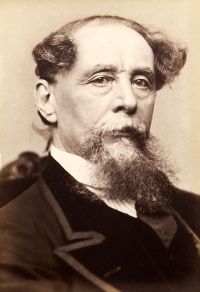
Charles Dickens

Charles Dickens

Summary

Portrait of Charles Dickens Charles Dickens Bleak House — Chapter XXII: Mr… (1852)

Tulkinghorn’s windows, and plenty more has generated among his furniture and papers. It lies thick everywhere. When a breeze from the country that has lost its way takes fright and makes a blind hurry to rush out again, it flings as much dust in the eyes of Allegory as the law—or Mr. Tulkinghorn, one of its trustiest representatives—may scatter, on occasion, in the eyes of the laity.
Source: Wikisource

Portrait of Charles Dickens Charles Dickens Bleak House — Chapter XXII: Mr… (1852)

The Colonel is produced, but is not at all near the thing. Whenever Mr. Snagsby and his conductors are stationary, the crowd flows round, and from its squalid depths obsequious advice heaves up to Mr. Bucket. Whenever they move, and the angry bull’s-eyes glare, it fades away and flits about them up the alleys, and in the ruins, and behind the walls, as before.
At last there is a lair found out where Toughy, or the Tough Subject, lays him down at night; and it is thought that the Tough Subject may be Jo.
Source: Wikisource

Portrait of Charles Dickens Charles Dickens Bleak House — Chapter XXII: Mr… (1852)

Allegory looks pretty cool in Lincoln’s Inn Fields, though the evening is hot, for both Mr. Tulkinghorn’s windows are wide open, and the room is lofty, gusty, and gloomy. These may not be desirable characteristics when November comes with fog and sleet or January with ice and snow, but they have their merits in the sultry long vacation weather. They enable Allegory, though it has cheeks like peaches, and knees like bunches of blossoms, and rosy swellings for calves to its legs and muscles to its arms, to look tolerably cool to-night.
Source: Wikisource

Get perspective with Kwize: daily news enlightened by great literature