Summary

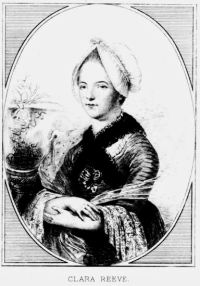
Portrait of Clara Reeve Clara Reeve The Old English Baron — Part X (1777)

The Baron's heart was touched, he turned away his face.
"Oh, Sir Philip Harclay, what a friend are you! why should such a man be our enemy?"
"My lord," said Sir Philip, "we are not, cannot be enemies; our hearts are already allied; and I am certain we shall one day be dear friends."
The Baron suppressed his emotions, but Sir Philip saw into his heart.
"I must consult my eldest son," returned he.
"Then," replied Sir Philip, "I foresee much difficulty; he is prejudiced against Edmund, and thinks the restitution of his inheritance an injury to your family.
Source: Wikisource

Portrait of Clara Reeve Clara Reeve The Old English Baron — Part X (1777)

Lord Graham applauded Sir Philip's appeal, affirming his own impartiality, and calling upon Lord Clifford and his son, and also his own nephews who were present. Lord Clifford said —
"Sir Philip offers fairly, and like himself; there can be no place nor persons more impartial than the present, and I presume the Lord Lovel can have no objection."
"No objection!" answered he; "what, to be tried like a criminal, to have judges appointed over me, to decide upon my right to my own estate and title?
Source: Wikisource

Portrait of Clara Reeve Clara Reeve The Old English Baron — Part X (1777)

Of the murder of the late Lord there is no doubt; the criminal hath confessed it, and the circumstances confirm it; the proofs of his crime are so connected with those of the young man's birth, that one cannot be public without the other. We are desirous to do justice; and yet are unwilling, for the Lord Fitz-Owen's sake, to bring the criminal to public shame and punishment. We wish to find out a medium; we therefore desire Sir Philip to make proposals for his ward, and let Lord Fitz-Owen answer for himself and his brother, and we will be moderators between them.
Source: Wikisource

Get perspective with Kwize: daily news enlightened by great literature