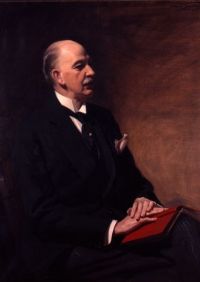
Clarence Winthrop Bowen

Clarence Winthrop Bowen

Summary

Portrait of Clarence Winthrop Bowen Clarence Winthrop Bowen Woodstock: An historical sketch

Many blows of the chisel were necessary to disclose the perfect ideal to the eyes of a wondering world. In thought, in plan, in ideal, this town has been almost a perfect organization; but only those whose high vision is willing to pierce through all encrusting imperfections shall be the artists whose toil and sacrifices shall make this dear, noble, historic town of Woodstock an honor to the State and a blessing to its citizens. It is said that old John Eliot, from the high pulpit in Roxbury, used to pray every Sabbath for the new settlers at Woodstock.
Source: Gutenberg

Portrait of Clarence Winthrop Bowen Clarence Winthrop Bowen Woodstock: An historical sketch

I have given scarce more than a sketch in outline of what the history of Woodstock has been during the two hundred years since that historic band of brave boys and sturdy men, of deft-handed girls and sober matrons, swarmed like bees from the Roxbury hive104 and settled on the Wabbaquasset hills. What Woodstock’s history shall be remains for you, men and women of Woodstock, to develop.
Source: Gutenberg

Portrait of Clarence Winthrop Bowen Clarence Winthrop Bowen Woodstock: An historical sketch

But the chief glory of the town of Woodstock has been its love of local law. The source of the power of the continental nations of Europe may be traced back through the centuries to the village communities [Pg 60] and Teutonic townships. In the mark, tithing, and parish of England the same principle of local self-government may be seen; and so our own nation’s greatness, through Anglo-Saxon inheritance, has its source, not in the State, city, or county, but in the little school districts, villages, and towns of New England.
Source: Gutenberg

Get perspective with Kwize: daily news enlightened by great literature