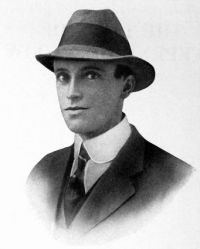
Daniel Thomas Curtin

Daniel Thomas Curtin

Summary

Portrait of Daniel Thomas Curtin Daniel Thomas Curtin The Czechoslovak Review (1917)

No nation should seek to extend its polity over any other nation or people, but every people should be left free to determine its own policy, its own way of development, unhindered, unthreatened, unafraid, the little along with the great and powerful.”
The realization of these admirable sentiments presents infinite problems in various section of Europe, but nowhere, perhaps, more than in Austria-Hungary. In his heterogeneous collection of peoples, the old Emperor had to make a choice between two courses in order to hold his thirteen distinct races together in one Empire.
Source: Wikisource

Portrait of Daniel Thomas Curtin Daniel Thomas Curtin The Czechoslovak Review (1917)

Like the German Government in the matter of Alsace-Lorraine, the Austrian Government has endeavored to mislead public opinion in foreign countries as to the state of mind of the Czechs by false information and to conceal the true military and political situation from the population at home. Austria’s first problem at the outbreak of war—a problem which has been worked out to the last detail—was rapidly to move the soldiers of the subjugated races from their native lands.
Source: Wikisource

Portrait of Daniel Thomas Curtin Daniel Thomas Curtin The Czechoslovak Review (1917)

The description of the relations of the various peoples and the “Unity-Machine” employed would fill a large book. Control of public opinion has been the first action of the rulers of the Dual Monarchy. In peace time, not only were the suppressed nations, such as the Czechs, Slovaks, Rumanians, Ruthenians, Poles, Slovenes, Italians, but all the citizens of Austria-Hungary, denied the right of free speech and freedom of the Press.
Source: Wikisource

Get perspective with Kwize: daily news enlightened by great literature