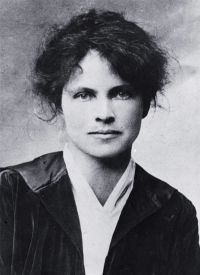
Dorothy Canfield

Dorothy Canfield

Summary

Portrait of Dorothy Canfield Dorothy Canfield Poet and Scullery-Maid (1908)

She found out where the poet's room was, and whenever she could she would slip away to try and catch a glimpse of him. But though he passed her several times on the stairs, he did not notice her. He was so busy living the life of an old, old woman whom he had seen on the other side of town that he could think of nothing else. Still, it was a joy to the scullery-maid even to see him, and as she sat on the platform, peeling potatoes, she thought how yellow his hair was, and how blue his eyes, instead of listening to the river which had comforted her so long.
Source: Wikisource

Portrait of Dorothy Canfield Dorothy Canfield Poet and Scullery-Maid (1908)

Then it sang so gallant and heartening a song that the little scullery-maid forgot how she hated the kitchen and the greasy dishes, forgot that she had no friends and no sweetheart. She only felt glad that she was alive, and faced bravely a long future of bad-tempered cooks and unpleasant smells.
Now one of the people who lived in the boarding-house was a poet—a really, truly poet, although people did not know it yet, for he was only a young man and looked like any one else, except that he often forgot to shave himself.
Source: Wikisource

Portrait of Dorothy Canfield Dorothy Canfield Poet and Scullery-Maid (1908)

He had forgotten everything else, and imagined that he too was a maid and lived in a greasy kitchen with only the sound of a river for comfort.
For that is the way with a poet. If he gets interested in somebody's point of view, he steps in and pushes the owner out of the way and lives his life for a while. The scullery-maid below stairs did not know that the blond young man on the fourth floor was washing her dishes, peeling her potatoes, and dreading with her the harsh voice of the cook
Source: Wikisource

Get perspective with Kwize: daily news enlightened by great literature