Summary

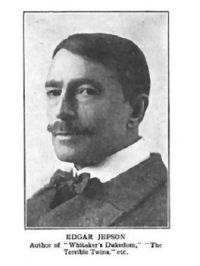
Portrait of Edgar Jepson Edgar Jepson,  Garthoyle Gardens — Chapter IV (1913)

“ We should have a monopoly. There would be no room for those wretched middle classes and the rest of the lower orders. Still, there are a few of us who devote ourselves to public affairs. I myself have figured largely in public life for many years, not only as president of the Landlords' Defense League, but in many other ways as the stanch opponent of the forces that threaten our order with destruction. I have made enemies—many dangerous enemies—by stemming the flood of anarchy and socialism that is striving to sweep us away. I am a barrier, Lord Garthoyle—a barrier. ”
Source: Wikisource

Portrait of Edgar Jepson Edgar Jepson,  Garthoyle Gardens — Chapter IV (1913)

“ Then I said:
“I should have thought you would have been glad to be rid of your fear of anarchists.”
“When I think of what I have suffered, I could curse my daughter—curse her, Lord Garthoyle!” he squeaked.
“Yes. That's all right,” I said. “But the worst thing is that your public work is spoiled for good and all.”
“Why, how?” he squeaked.
“When it comes to be known that you've made all this fuss about some lovers' signals, you'll be the laughingstock of the country; and no one will ever take you seriously again.”
”
Source: Wikisource

Portrait of Edgar Jepson Edgar Jepson,  Garthoyle Gardens — Chapter IV (1913)

“ Sir Marmaduke introduced her to me as his daughter, Muriel, and I explained:
“I was just looking at the hieroglyphics. I don't see that they're coffins and bombs and infernal machines.”
“I say they are, and Mr. Manders agrees with me,” said Sir Marmaduke solemnly, in a disagreeable tone.
“Mr. Manders always agrees with you. They're just scrawls,” she said sharply.
“I never expect any sympathy or understanding from you, Muriel. I do not look for it. We are agreed that the figures are a coffin, a bomb, an infernal machine, a bomb of a different pattern, and the figure four.”
”
Source: Wikisource

Get perspective with Kwize: daily news enlightened by great literature