Summary

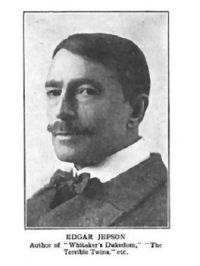
Portrait of Edgar Jepson Edgar Jepson The Garden at No. 19 — Chapter 5 (1910)

No, there is no good book on the Mysteries. Gibson says that they are the same, or very nearly the same as the mysteries which savages still celebrate all the world over. But he is too full of the spirit of vegetation, the Culture God. But he does not pretend to be an authority."
"What, do you think, is the significance of the Mysteries?" I said.
"I don't know. I have never worked at the ancient Mysteries. Perhaps I shall know—some day."
"Does anyone know?"
"Probably not. Your neighbor here, Woodfell, could tell you more about them than anyone alive probably.
Source: Wikisource

Portrait of Edgar Jepson Edgar Jepson The Garden at No. 19 — Chapter 5 (1910)

Those are the mysteries worth knowing."
"And Woodfell knows them?"
"I do not know," said Marks.
We were silent awhile, and as he puffed at his pipe, the serene content, which the name of Pumber had vanished, settled down again on his face.
Presently I said: "Isn't it dangerous to tamper with these things —with the occult?"
"Really to tamper with them seems to be one of the most dangerous things in the world—for those who have not passed through the training."
"Is that why you don't like the idea of Miss Woodfell's living at No. 19?" I said.
Source: Wikisource

Portrait of Edgar Jepson Edgar Jepson The Garden at No. 19 — Chapter 5 (1910)

Marks rose and crossed the room to my book-shelves. "I never said so," he said uneasily.
"Well, to be quite frank with you, I take an interest in Miss Woodfell, and I don't like to think of her being in danger," I said. "What is the danger in these matters?"
Marks looked at me gravely, hesitating; then he said slowly: "Well, you see, the master is supposed to gain control, by a process or series of processes, of certain powers—some of them malefic, some beneficent. To gain, and still more to keep, that control he needs an enormous personal force."
Source: Wikisource

Get perspective with Kwize: daily news enlightened by great literature