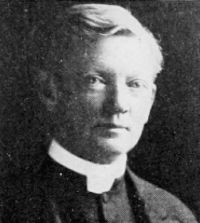
Edward Aloysius Pace

Edward Aloysius Pace

Summary

Portrait of Edward Aloysius Pace Edward Aloysius Pace Catholic Encyclopedia (1913)

To say that God is the Absolute is equivalent to saying that He is unknowable.—This view, expressed by Hamilton and Mansel, and endorsed by Spencer in his "First Principles", affords an apparently strong support to Agnosticism, while it assails both the reasonableness and the possibility of religion. It is only a partial reply to state that God, though incomprehensible, is nevertheless knowable according to the manner and capacity of our intelligence. The Agnostic contends that God, precisely because He is the Absolute, is beyond the range of any knowledge whatever on our part.
Source: Wikisource

Portrait of Edward Aloysius Pace Edward Aloysius Pace Catholic Encyclopedia (1913)

Absolute, The, a term employed in modern philosophy with various meanings, but applied generally speaking to the Supreme Being. It signifies (1) that which is complete and perfect; (2) that which exists by its own nature and is consequently independent of everything else; (3) that which is related to no other being; (4) the sum of all being, actual and potential (Hegel) . In the first and the second of these significations the Absolute is a name for God which Christian philosophy may readily accept.
Source: Wikisource

Portrait of Edward Aloysius Pace Edward Aloysius Pace Catholic Encyclopedia (1913)

The fashion of our thought obliges us to conceive God as one term of a relation, but not to infer that the relation affects Him as it affects the created thing which is the other term. This distinction, moreover, is based on experience. The process of knowledge involves a relation between the known object and, the knowing subject, but the character of the relation is not the same in both terms. In the mind it is real because perception and thought imply the exercise of mental faciilties, and consequently a modification of the mind itself.
Source: Wikisource

Get perspective with Kwize: daily news enlightened by great literature