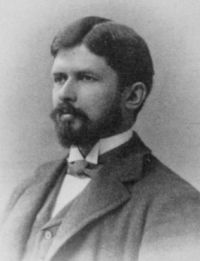
Edward Gaylord Bourne

Edward Gaylord Bourne

Summary

Portrait of Edward Gaylord Bourne Edward Gaylord Bourne The American Historical Review (1901)

An exclamation of joy burst from the whole table, at first unaccountable to Doctor Whitman, till a young priest, perhaps not so discreet as the older, and not thinking that there was an American at the table, sprang to his feet, and swinging his hand, exclaimed: "Hurrah for Columbia! (Oregon.) America is too late; we have got the country." In an instant, as by instinct. Dr. Whitman saw through the whole plan, clear to Washington, Fort Hall, and all.
Source: Wikisource

Portrait of Edward Gaylord Bourne Edward Gaylord Bourne The American Historical Review (1901)

History is full of such touches, which if not true are not essential distortions of the train of events. For examples of the complete legendary reconstruction of history we naturally turn to the Middle Ages or earlier periods, and call to mind the Donation of Constantine or the story of William Tell. That such a reconstruction of history should take place in the latter half of the nineteenth century in the United States and should involve an event of such immense importance and world-wide publicity as the acquisition of Oregon will seem little short of incredible.
Source: Wikisource

Portrait of Edward Gaylord Bourne Edward Gaylord Bourne The American Historical Review (1901)

Yet it is the true Marcus Whitman whom they wish to honor, the devoted and heroic missionary who braved every hardship and imperilled his life for the cause of Christian missions and Christian civilization in the far Northwest and finally died at his post, a sacrifice to the cause, and not a political deus ex machina, a figment of H. H. Spalding's invention.
Source: Wikisource

Get perspective with Kwize: daily news enlightened by great literature