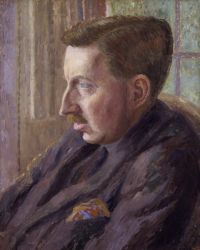
Edward Morgan Forster

Edward Morgan Forster

Summary

Portrait of Edward Morgan Forster Edward Morgan Forster A Passage to India (1924)

There is no painting and scarcely any carving in the bazaars. The very wood seems made of mud, the inhabitants of mud moving. So abased, so monotonous is everything that meets the eye, that when the Ganges comes down it might be expected to wash the excrescence back into the soil. Houses do fall, people are drowned and left rotting, but the general outline of the town persists, swelling here, shrinking there, like some low but indestructible form of life.
Source: Wikisource

Portrait of Edward Morgan Forster Edward Morgan Forster A Passage to India (1924)

Aziz took his leave saying "Perhaps . . . but later . . ."—his invariable reply to such an appeal.
"You mustn't put off what you think right," said Hamidullah. "That is why India is in such a plight, because we put off things." But seeing that his young relative looked worried, he added a few soothing words, and thus wiped out any impression that his wife might have made.
During their absence, Mahmoud Ali had gone off in his carriage leaving a message that he should be back in five minutes, but they were on no account to wait.
Source: Wikisource

Portrait of Edward Morgan Forster Edward Morgan Forster A Passage to India (1924)

She has just taken my tonga without my permission—do you call that being charming?—and Major Callendar interrupts me night after night from where I am dining with my friends and I go at once, breaking up a most pleasant entertainment, and he is not there and not even a message. Is this charming, pray? But what does it matter? I can do nothing and he knows it. I am just a subordinate, my time is of no value, the verandah is good enough for an Indian, yes, yes, let him stand, and Mrs. Callendar takes my carriage and cuts me dead ...
Source: Wikisource

Get perspective with Kwize: daily news enlightened by great literature