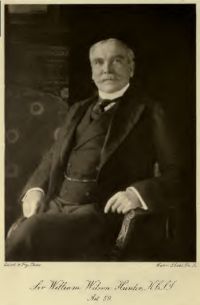
William Wilson Hunter

William Wilson Hunter

Summary

Portrait of William Wilson Hunter William Wilson Hunter Encyclopædia Britannica, Ninth Edition (1878)

But one of the first acts of the founder of the uew dynasty, Ghias-ud-din Taghlak, was to erect a new capital about four miles further to the east, which he called Taghlakdbdd. The ruins of his fort remain, and the eye can still trace the streets and lanes of the long deserted city. Ghias-ud-din was succeeded by his sou Muhammad Taghlak, who reigned from 1325 to 1351, and is described by Elphinstone as " one of the most accomplished princes and most furious tyrants that ever adorned or disgraced human nature." Under this monarch the Delhi of the Taghlak dynasty attained its utmost growth.
Source: Wikisource

Portrait of William Wilson Hunter William Wilson Hunter Encyclopædia Britannica, Ninth Edition (1878)

The siege which followed forms one of the memorable incidents of the British history of India. On the 8th June, four weeks after the outbreak, Sir II. Barnard, who had succeeded as commander-in-chief on the death of General Anson, routed the mutineers with a handful of Europeans and Sikhs, after a severe action at Badli-ka-Sardi, and encamped upon the ridge that overlooks the city. The force was too weak to capture the city, and he had no siege train or heavy guns. All that could be done was to hold the position till the arrival of reinforcements and of a siege train.
Source: Wikisource

Portrait of William Wilson Hunter William Wilson Hunter Encyclopædia Britannica, Ninth Edition (1878)

From this date a new era in the history of Delhi began. A pension of 120,000 per annum was allowed to the king, with ex clusive jurisdiction over the palace, and the titular sove reignty as before; but the city, together with the Delhi territory, passed under British administration. Fifty-three years of quiet prosperity for Delhi were brought to a close by the mutiny of 1857. Its capture by the mutineers, its siege, and its subsequent recapture by the British have been often told, and nothing beyond a short notice is called for here.
Source: Wikisource

Get perspective with Kwize: daily news enlightened by great literature