Summary

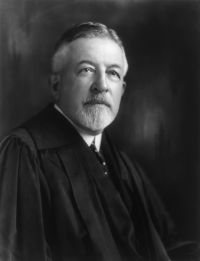
Portrait of Edward Terry Sanford Edward Terry Sanford District of Columbia v. Thompson…

Pursuant to the Act of Congress the strip of land was condemned for the extension of Lamont Street, an improved thoroughfare open for vehicular and pedestrian traffic and all the ordinary uses of a street. In the condemnation proceeding the jury were necessarily required to assess the benefits which would accrue from such extension, that is, from the extension of a street where one had not theretofore existed, and not from an unimproved strip of land merely.
Source: Wikisource

Portrait of Edward Terry Sanford Edward Terry Sanford District of Columbia v. Thompson…

The court said that 'the effect of the abandonment by the city of the project of 'extending and opening' the proposed street for and on account of which, and which only, the assessment was made, is that the consideration of the assessment has wholly failed. So that the city stands in the position of holding in its treasury money collected from the plaintiff which it has no right in equity, good conscience, or common honesty to retain, because the purpose for which it was collected has been completely abandoned.
Source: Wikisource

Portrait of Edward Terry Sanford Edward Terry Sanford District of Columbia v. Thompson…

However, since that time and up to the filing of the plaintiff's suit in 1927, Lamont Street had not been extended as an improved street, and the condemned strip had not been laid out for a roadway, sidewalk or parking space, nor graded, paved or otherwise improved for highway purposes; nor had Congress made any specific appropriation therefor. And although lying between two improved highways, 19th Street and Adams Mill Road, it still remained open, vacant property.
Source: Wikisource

Get perspective with Kwize: daily news enlightened by great literature