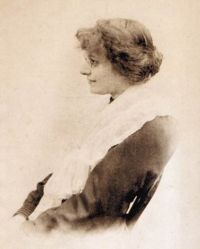
Eleanor Farjeon

Eleanor Farjeon

Summary

Portrait of Eleanor Farjeon Eleanor Farjeon,  St. Nicholas (1914)

“ If you know Arthur Rackham’s fairy-land of books—if you know ancient Æsop and modern Peter, and their immortal equals, Rip, Undine and Alice, Puck and Mother Goose; if you know Grimm, who is better than painted gingerbread and striped sugar-sticks, and if you know the gods and giants and dwarfs and nymphs of the legendary Rhine—not only through the wonder-makers who first shaped them for our hearts, but also through the wonder-maker who has reshaped them for our eyes—then you really know as much of Arthur Rackham as can be told. ”
Source: Wikisource

Portrait of Eleanor Farjeon Eleanor Farjeon,  St. Nicholas (1914)

“ And the seen has as much enchantment as the unseen, the tree-tops as much fairyhood as the tree-trunks, the colors of the Serpentine as much mystery as the glimmering fairy lights which it reflects.
When the wizard shows us the delicate webs of leafless branches traced against a wintry sky, when he paints evening light for us, or pale marbled clouds, or patterns upon water, or children and flowers as well as fairies in the Gardens—then he reveals a magic which Londoners may encounter day by day.
”
Source: Wikisource

Portrait of Eleanor Farjeon Eleanor Farjeon,  St. Nicholas (1914)

“ I had always had the impression, from the intimate inside knowledge of Fairy-land which his work betrayed, that Arthur Rackham was a kind of wizard: that he only pretended to call himself Arthur Rackham, and hobgoblins really hailed him by some more mystic name on stormy nights on Hanmpstead Heath, which is an easy broomstick ride from a certain little house in Chalcot Gardens. Acquaintance has not entirely allayed the suspicion. Arthur Rackham looks rather like a wizard—a wizard of the unmalicious order, who dabbles in sly, freakish, and delightful arts. ”
Source: Wikisource

Get perspective with Kwize: daily news enlightened by great literature