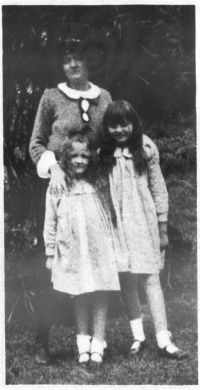
Elisabeth Sanxay Holding

Elisabeth Sanxay Holding

Blotted Out (1926)

Summary

Portrait of Elisabeth Sanxay Holding Elisabeth Sanxay Holding Blotted Out (1926)

Jones knocked upon a door.
“Miss Amy, my pet!” she called, softly.
The door opened a little.
“The gentleman,” said Mrs. Jones. “He will see you!”
“All right!” answered a voice he recognized; the door opened wider, and there was the girl he had seen before. Her body, in that soft gray dress, seemed almost incredibly fragile; her face, colorless, framed in misty black hair, with great, restless black eyes and delicate little features, was strange and lovely as a dream.
Too strange, thought Ross. For the first time he realized the significance of her presence in the housekeeper’s room.
Source: Gutenberg

Portrait of Elisabeth Sanxay Holding Elisabeth Sanxay Holding Blotted Out (1926)

Ross hesitated for a moment; then he wrote “J. Ross, New York.” After all, this was his home; he had been born here, and he intended to live here.
He went upstairs to his room, and, locking the door, sat down near the window. The floor still seemed to heave under his feet, like the deck of a ship. He visualized the deck of the Farragut, and Phyllis in a deck chair, looking at him with her dear, friendly little smile.
Source: Gutenberg

Portrait of Elisabeth Sanxay Holding Elisabeth Sanxay Holding Blotted Out (1926)

He put on a suit of overalls he found in the garage; he started the engine and opened the hood; he was so pleased with that fine roar, that powerful vibration which was like the beat of a great, faithful heart, that he began to whistle. A superb motor; he would enjoy driving that car.
“She’s a beauty, all right!” said a voice, so very close to his ear that he jumped.
Standing at his elbow was a burly fellow of thirty-five or so, with a bulldog jaw; his voice and his smile were friendly, but his blue eyes, Ross thought, were not.
“Yes, sir!” he went on. “You’ve got a mighty fine car there.”
Source: Gutenberg

Get perspective with Kwize: daily news enlightened by great literature