Summary

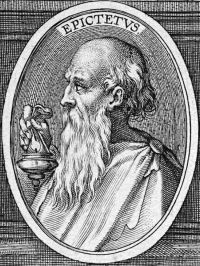
Portrait of Epictetus Epictetus Epictetus, the Discourses as reported by Arrian… (1925)

No one? Assuredly from the very structure of all made objects we are accustomed to prove that the work is certainly the product of some artificer, and has not been constructed at random.
Does, then, every such work reveal its artificer, but do visible objects and vision and light not reveal him? And the male and the female, and the passion of each for intercourse with the other, and the faculty which makes use of the organs which have been constructed for this purpose, do these things not reveal their artificer either? Well, admit it for these things
Source: Wikisource

Portrait of Epictetus Epictetus Epictetus, the Discourses as reported by Arrian… (1925)

But God has brought man into the world to be a spectator of Himself and of His works, and not merely a spectator, but also an interpreter. 20Wherefore, it is shameful for man to begin and end just where the irrational animals do; he should rather begin where they do, but end where nature has ended in dealing with us. Now she did not end until she reached contemplation and understanding and a manner of life harmonious with nature. Take heed, therefore, lest you die without ever having been spectators of these things.
Source: Wikisource

Portrait of Epictetus Epictetus Epictetus, the Discourses as reported by Arrian… (1925)

Is it not that you may wipe your nose? "Is it reasonable, then, that there should be running noses in the world?"—And how much better it would be for you to wipe your nose than to find fault! Or what do you think Heracles would have amounted to, if there had not been a lion like the one which he encountered, and a hydra, and a stag, and a boar, and wicked and brutal men, whom he made it his business to drive out and clear away?
Source: Wikisource

Get perspective with Kwize: daily news enlightened by great literature