Summary

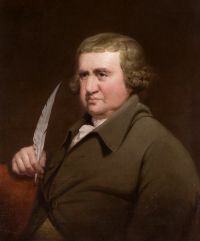
Portrait of Erasmus Darwin Erasmus Darwin Zoonomia, or, the Laws of Organic Life… (1796)

When the paralysis of the hepatic glands is less complete, or less universal, a schirrosity of some part of the liver is induced; for the secretory vessels retaining some of their living power take up a fluid from the circulation, without being sufficiently irritable to carry it forwards to their excretory ducts; hence the body, or receptacle of each gland, becomes inflated, and this distension increases, till by its very great stimulus inflammation is produced, or till those parts of the viscus become totally paralytic.
Source: Wikisource

Portrait of Erasmus Darwin Erasmus Darwin Zoonomia, or, the Laws of Organic Life… (1796)

There is reason to believe, that the bile is most frequently returned into the circulation by the inverted motions of these hepatic glands, for the bile does not seem liable to be absorbed by the lymphatics, for it soaks through the gall-ducts, and is frequently found in the cellular membrane. This kind of jaundice is not generally attended with pain, neither at the extremity of the bile-duct, where it enters the duodenum, nor on the region of the gall-bladder.
Source: Wikisource

Portrait of Erasmus Darwin Erasmus Darwin Zoonomia, or, the Laws of Organic Life… (1796)

This palsy of the liver is known from these symptoms, the patients have generally passed the meridian of life, have drank fermented liquors daily, but perhaps not been opprobrious drunkards; they lose their appetite, then their flesh and strength diminish in consequence, there appears no bile in their stools, nor in their urine, nor is any hardness or swelling perceptible on the region of the liver.
Source: Wikisource

Get perspective with Kwize: daily news enlightened by great literature