Summary

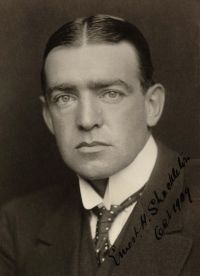
Portrait of Ernest Henry Shackleton Ernest Henry Shackleton South: the story of Shackleton's last expedition… (1920)

She has been nipped with a million-ton pressure and risen nobly, falling clear of the water out on the ice. She has been thrown to and fro like a shuttlecock a dozen times. She has been strained, her beams arched upwards, by the fearful pressure; her very sides opened and closed again as she was actually bent and curved along her length, groaning like a living thing. It will be sad if such a brave little craft should be finally crushed in the remorseless, slowly strangling grip of the Weddell pack after ten months of the bravest and most gallant fight ever put up by a ship.
Source: Wikisource

Portrait of Ernest Henry Shackleton Ernest Henry Shackleton South: the story of Shackleton's last expedition… (1920)

From the mast-head the mirage is continually giving us false alarms. Everything wears an aspect of unreality. Icebergs hang upside down in the sky; the land appears as layers of silvery or golden cloud. Cloud-banks look like land, icebergs masquerade as islands or nunataks, and the distant barrier to the south is thrown into view, although it really is outside our range of vision. Worst of all is the deceptive appearance of open water, caused by the refraction of distant water, or by the sun shining at an angle on a field of smooth snow or the face of ice-cliffs below the horizon.
Source: Wikisource

Portrait of Ernest Henry Shackleton Ernest Henry Shackleton South: the story of Shackleton's last expedition… (1920)

The James Caird remained moored to the ice, with the Dudley Docker and the Stancomb Wills in line behind her. The darkness had become complete, and we strained our eye to see the fragments of ice that threatened us. Presently we thought we saw a great berg bearing down upon us, its form outlined against the sky, but this startling spectacle resolved itself into a low-lying cloud in front of the rising moon. The moon appeared in a clear sky. The wind shifted to the south-east as the light improved and drove the boats broadside on towards the jagged edge of the floe.
Source: Wikisource

Get perspective with Kwize: daily news enlightened by great literature