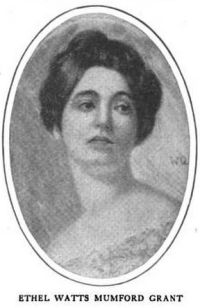
Ethel Watts Mumford

Ethel Watts Mumford

Summary

Portrait of Ethel Watts Mumford Ethel Watts Mumford Siren Cottage (1920)

All the old-fashioned flowers of a hardy garden had made the lawns a battle-ground for floral supremacy, surging about the house, swarming at the windows, meeting the hosts of roses and honeysuckle that fell from roof and balcony.
The bride and the groom stood hand in hand, gazing wide-eyed at the scene before them. It was almost too wonderful, too perfect. A house of dreams—the painted back-drop of a fairy play that might at any moment roll up into the heavens and be lost to reality.
Source: Wikisource

Portrait of Ethel Watts Mumford Ethel Watts Mumford Siren Cottage (1920)

The bride looked over her shoulder as they topped the hill. Below them lay the tangled garden, the shimmer of the pond, the inviting expanse of the house, cream-white in its setting of green. On the steps was a splotch of gray—the huddled figure of the watcher.
"Bughouse, poor old boy!" said the groom. "But, after all, there's something in what he says about biting off more than one can chew. Considerable of a yarn, that. Wonder if there's any basis of truth for it—all that about the suicide, and his wife eloping, I mean."
Source: Wikisource

Portrait of Ethel Watts Mumford Ethel Watts Mumford Siren Cottage (1920)

THE bride gave a sudden exclamation as the automobile surmounted the crest of the hill, disclosing an embowered glimpse of the house and the riot of its neglected gardens. Only the wildly yawing wheel of the little car prevented her laying an arresting hand upon that of her husband.
"My goodness!" she gasped. "How could that ever have been a workhouse? Why, it's a playhouse—a sublime, adorable playhouse! No wonder the town gave it up. It's too ridiculous—everybody would want to be a pauper!"
Source: Wikisource

Get perspective with Kwize: daily news enlightened by great literature