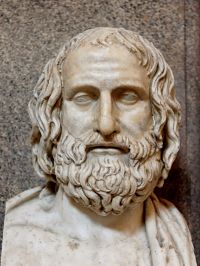
Euripides

Euripides

Summary

Portrait of Euripides Euripides,  Trojan Women (1905)

“ The consummation of a great conquest, a thing celebrated in paeans and thanksgivings, the very height of the day-dreams of unregenerate man—it seems to be a great joy, and it is in truth a great misery. It is conquest seen when the thrill of battle is over, and nothing remains but to wait and think. We feel in the background the presence of the conquerors, sinister and disappointed phantoms; of the conquered men, after long torment, now resting in death. But the living drama for Euripides lay in the conquered women. ”
Source: Wikisource

Portrait of Euripides Euripides,  Trojan Women (1905)

“ If one tries to imagine what Athena, the War-Goddess worshipped by the Athenian mob, was like—what a mixture of bad national passions, of superstition and statecraft, of slip-shod unimaginative idealisation—one may partly understand why Euripides made her so evil. Allegorists and high-minded philosophers might make Athena entirely noble by concentrating their minds on the beautiful elements in the tradition, and forgetting or explaining away all that was savage ”
Source: Wikisource

Portrait of Euripides Euripides,  Trojan Women (1905)

“ All through the play Hecuba is a woman of remarkable intellectual power and of fearless thought. She does not definitely deny the existence of the Olympian gods, like some characters in Euripides, but she treats them as beings that have betrayed her, and whose name she scarcely deigns to speak. It is the very godlessness of Hecuba's fortitude that makes it so terrible and, properly regarded, so noble. ”
Source: Wikisource

Get perspective with Kwize: daily news enlightened by great literature